

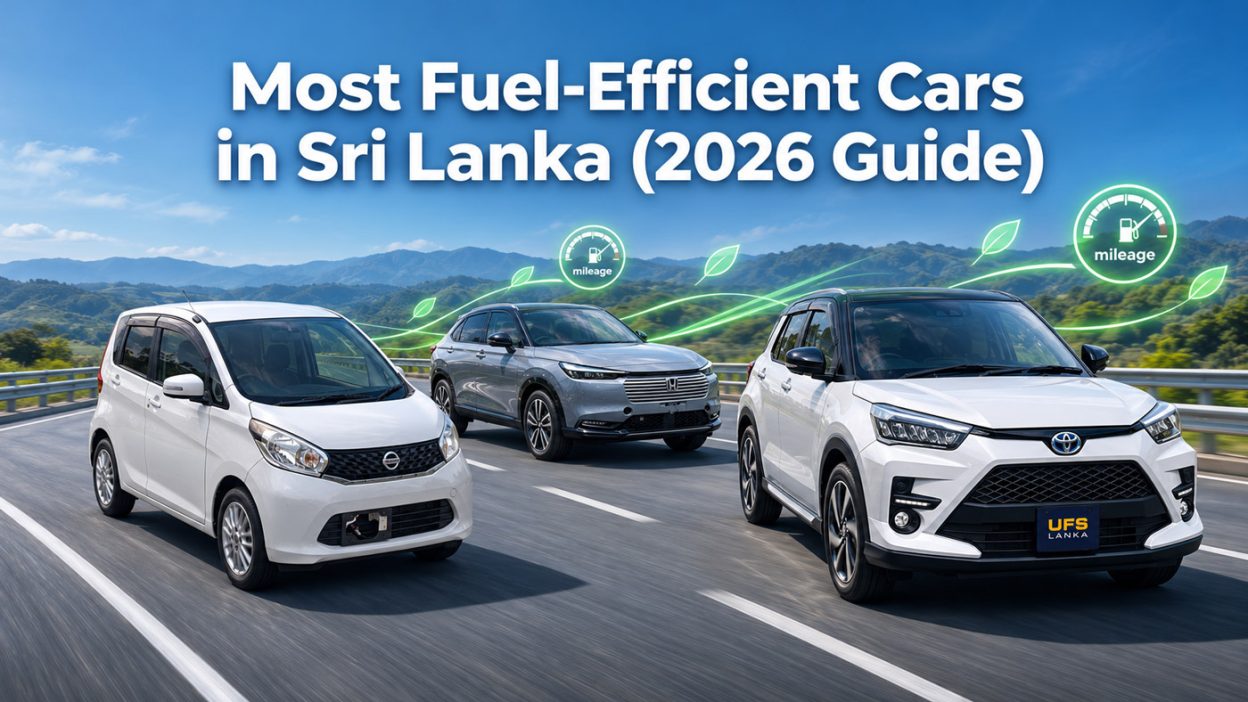
Short answer: For Colombo-style traffic, the most fuel-efficient cars you can import to Sri Lanka in 2026 are small hybrids. The Toyota Raize Hybrid and its twin, the Daihatsu Rocky Hybrid, return about 21-22 km/L in real-world mixed driving; the Nissan Dayz Highway Star Hybrid manages roughly 21-25 km/L; and the Toyota Yaris Cross Hybrid (WLTC up to 30.8 km/L) and Honda Vezel e:HEV (WLTC up to 26.0 km/L) lead the bigger crossovers. Kei cars such as the Wagon R Hybrid (WLTC 25.1) are the cheapest to run on a tight budget. Prices change daily: contact UFS Lanka on 0773166518 for today’s price.
Petrol 92 went up again on 1 November. Ceypetco added another Rs. 10, taking it to Rs. 424 a litre (Newswire, 1 Nov 2026). If you drive to work, you probably noticed it the first time you filled up this month. At UFS Lanka, we’ve noticed buyers asking a different first question. It used to be “Which car looks good?” Now it is “Which car will cost me least every month?”
So here’s our honest answer, backed by numbers rather than sales talk. We ranked the fuel-efficient cars Sri Lankans actually import from Japan and India, and we keep two kinds of figures separate: official test figures (Japan’s WLTC, or India’s certified rating) and real-world figures from Sri Lankan driving: Colombo traffic, outstation roads and the expressway. If we only have the official figure for a car, we tell you.
Most fuel-efficient cars in Sri Lanka: the 2026 ranking
We ranked these cars on what you can realistically expect on Sri Lankan roads, and put the official figures next to them. Real-world numbers come from our model guides and owner feedback; your own result depends on traffic, air-conditioning use and how you drive.
| # | Model | Type | Official figure | Real-world in Sri Lanka |
|---|---|---|---|---|
| 1 | Toyota Raize Hybrid / Daihatsu Rocky Hybrid | Compact SUV, series hybrid | Rocky Hybrid WLTC 28.0 km/L (urban 29.6) | 21-22 km/L mixed; 18-20 heavy Colombo traffic; 23-26 highway |
| 2 | Nissan Dayz Highway Star Hybrid | Kei car, mild hybrid | – | 21-25 km/L |
| 3 | Toyota Yaris Cross Hybrid | Compact SUV, full hybrid | WLTC up to 30.8 km/L | 20-24 km/L outstation; 17-21 expressway |
| 4 | Honda Vezel e:HEV | Compact SUV, full hybrid | WLTC up to 26.0 km/L (RS FF about 25.4) | We haven’t tested it yet |
| 5 | Suzuki Grand Vitara Strong Hybrid | Mid-size SUV, full hybrid | 27.97 km/L certified (Smart Hybrid: 21.11) | We haven’t tested it yet |
| 6 | Suzuki Wagon R Hybrid ZX (2WD) | Kei car, mild hybrid | WLTC 25.1 km/L | We haven’t tested it yet |
| 7 | Mitsubishi eK Wagon (2WD) | Kei car | WLTC 23.2 km/L | We haven’t tested it yet |
| 8 | Daihatsu Move G | Kei car | WLTC 22.6 km/L | We haven’t tested it yet |
| 9 | Toyota Taisor / Suzuki Fronx | Compact crossover, petrol | 19.86 km/L (1.0 turbo AT) to 22.79 km/L (1.2 AMT) | 15-20 km/L (owners report 16.5-18) |
| 10 | Toyota Yaris (petrol) | Hatchback | No official figure | 16-20 km/L mixed; 11-14 Colombo; 23-26 expressway |
| 11 | Volkswagen T-Cross | Compact SUV, turbo petrol | No official figure | 17-20 km/L |
Official figures are laboratory results and are almost always higher than what you will see in Sri Lanka. Use them to compare cars, not as a promise of what you’ll get.
What will each car cost you in fuel?
At Rs. 424 a litre, the difference between a 15 km/L car and a 25 km/L car adds up fast. Here’s what you’d spend on petrol for every 1,000 km, which is about a month of driving for many Colombo commuters:
| Average economy | Fuel used per 1,000 km | Petrol 92 cost per 1,000 km | Typical cars |
|---|---|---|---|
| 12 km/L | 83 litres | Rs. 35,333 | Heavy-traffic petrol SUV or hatchback |
| 15 km/L | 67 litres | Rs. 28,267 | Petrol crossover in mixed driving |
| 18 km/L | 56 litres | Rs. 23,556 | Taisor, Fronx, Yaris on a good month |
| 21 km/L | 48 litres | Rs. 20,190 | Raize Hybrid, Rocky Hybrid in mixed use |
| 25 km/L | 40 litres | Rs. 16,960 | Dayz Hybrid or a kei car driven gently |
Moving from a 15 km/L car to a 21 km/L hybrid saves around Rs. 8,000 for every 1,000 km at today’s petrol price. Drive 1,500 km a month and that is roughly Rs. 12,000 a month, well over Rs. 140,000 a year. Fuel prices move often, so plug in the current Ceypetco price to update these numbers.
The cars, one by one
1. Toyota Raize Hybrid and Daihatsu Rocky Hybrid
These two are really the same car with different badges. They top our list because their hybrid system is made for traffic like Colombo’s. The petrol engine mostly acts as a generator while an electric motor drives the wheels, so it actually does best in stop-start traffic, which is exactly where normal petrol cars waste the most fuel. Our Raize testing shows about 18-20 km/L in heavy Colombo traffic, 23-25 km/L in lighter traffic and up to 32 km/L when driven gently. Over a normal mixed week, 21-22 km/L is realistic. The Rocky Hybrid’s official WLTC figure is 28.0 km/L.
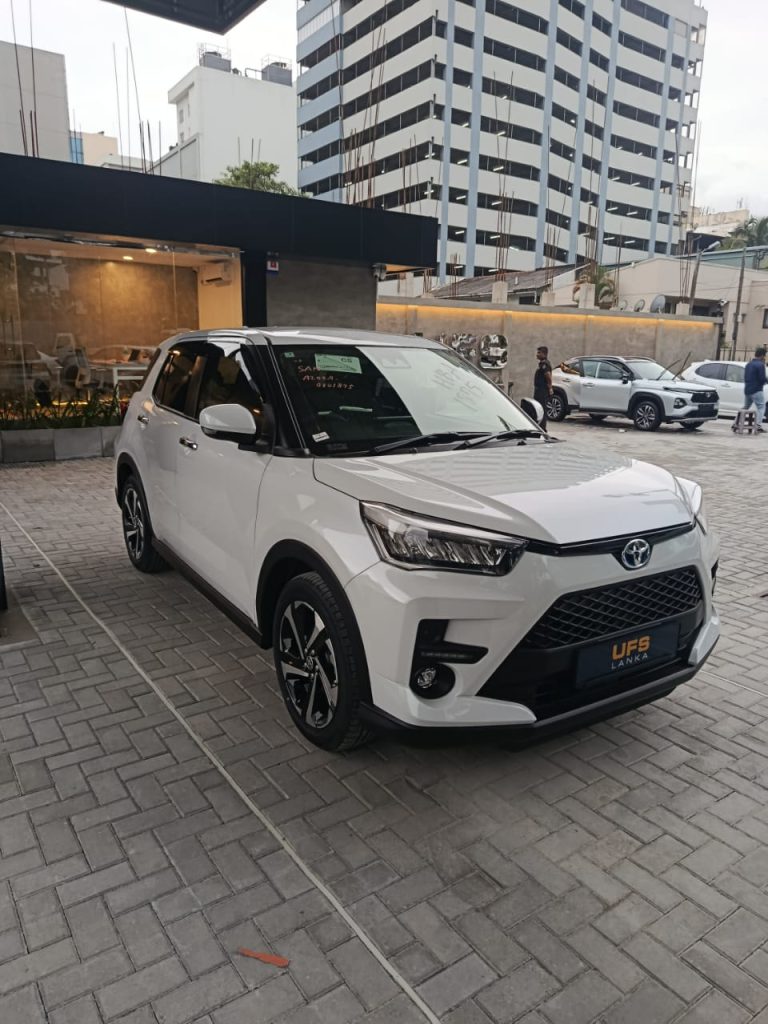
A quick warning: the petrol-only Raize is a very different car, at roughly 8-15 km/L in the city and 14-20 km/L on open roads. Always check which version you’re buying. Read more: Raize fuel consumption, Raize Hybrid review, Daihatsu Rocky Hybrid guide and Kia Sonet vs Toyota Raize.
2. Nissan Dayz Highway Star Hybrid
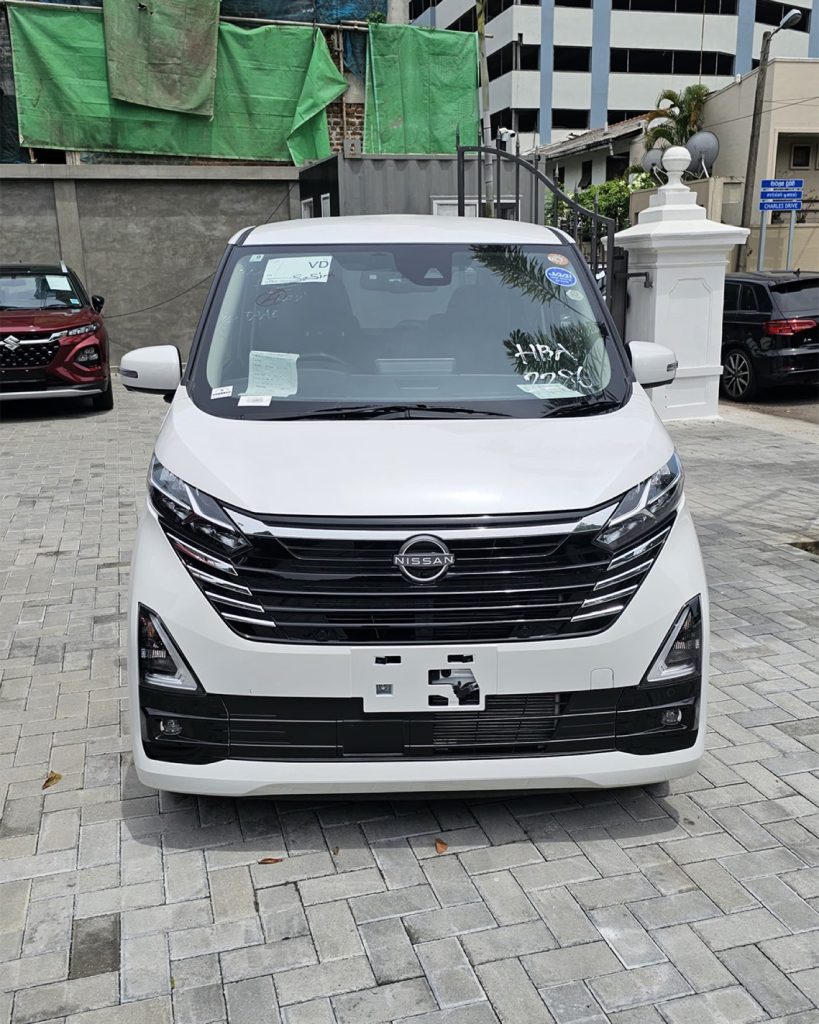
Kei cars are Japan’s answer to small, cheap, efficient city cars, and the Dayz Highway Star Hybrid is one of the most popular in Sri Lanka. Expect 21-25 km/L. It is narrow and light, easy to park in Wellawatte or Pettah, and the mild-hybrid system helps when pulling away. It has four seats and a small engine, so it’s not the car for taking the whole family up to the hill country. Nissan Dayz buyer’s guide.
3. Toyota Yaris Cross Hybrid
The Yaris Cross has the best official figure here, up to 30.8 km/L on the WLTC cycle. On Sri Lankan outstation roads we see 20-24 km/L, and 17-21 km/L at sustained expressway speeds, where hybrids lose some of their advantage. It is a good fit if you want SUV ride height and Toyota resale value with low running costs. Is the Yaris Cross worth buying?
4. Honda Vezel e:HEV
The Vezel (sold as the HR-V elsewhere) is the most premium-feeling car on this list, with a large cabin and Honda’s two-motor hybrid. Official WLTC economy is up to 26.0 km/L, about 25.4 km/L for the RS FF grade. Buyers choose it for space and comfort first; the economy is a strong bonus. Honda Vezel Sri Lanka import guide.
5. Suzuki Grand Vitara Hybrid
The Grand Vitara comes in two very different hybrids. The Strong Hybrid is certified at 27.97 km/L, remarkable for a mid-size SUV; the Smart (mild) Hybrid is rated at 21.11 km/L. If economy is your priority, insist on the Strong Hybrid. Grand Vitara Hybrid guide.
6, 7 and 8. Wagon R Hybrid, eK Wagon and Daihatsu Move
These kei cars are the cheapest way into low running costs. The Wagon R Hybrid ZX 2WD is rated at 25.1 km/L WLTC, the Mitsubishi eK Wagon 2WD at 23.2 km/L and the Daihatsu Move G at 22.6 km/L. All three are tall and roomy for their size, which helps for school runs and city errands. See Wagon R grades compared, Mitsubishi eK Wagon guide and Daihatsu Move guide.
9. Toyota Taisor and Suzuki Fronx
This is another pair of twins with different badges, both built in India. Official ratings run from 19.86 km/L (1.0 turbo automatic) to 22.79 km/L (1.2 AMT), with 21.71 km/L for the manual. Real-world Sri Lankan use comes in at 15-20 km/L, and owners commonly report 16.5-18 km/L. In heavy city traffic the 1.0 turbo can drop to 10-15 km/L. They’re good value, but they can’t match the hybrids. Taisor real-world mileage and Taisor vs Fronx.
10 and 11. Toyota Yaris and Volkswagen T-Cross
These are regular petrol cars, and they do well for what they are. The Yaris returns 16-20 km/L in mixed driving but only 11-14 km/L in Colombo traffic; on the expressway it reaches about 23-26 km/L. The T-Cross delivers about 17-20 km/L. They make sense if most of your driving is outstation. Toyota Yaris on Sri Lankan roads and VW T-Cross buyer guide.
Which type of car saves the most for your driving?
| If you mostly drive… | Best choice | Why |
|---|---|---|
| In Colombo stop-start traffic | Series or full hybrid (Raize/Rocky Hybrid, Yaris Cross, Vezel) | Electric drive does most of the low-speed work, so traffic costs least |
| Short city trips on a tight budget | Kei car (Dayz, Wagon R, eK Wagon, Move) | Light, small engines, cheapest to buy and run |
| Long outstation and expressway runs | Hybrid or an efficient petrol (Yaris, Taisor, T-Cross) | At steady speeds the hybrid advantage narrows |
| With a full family and luggage | Larger hybrid SUV (Vezel e:HEV, Grand Vitara Strong Hybrid) | Space without the fuel bill of a big petrol SUV |
Seven ways to get closer to the official figure
- Keep tyres at the pressure on the door sticker; under-inflated tyres quietly cost fuel.
- Drive smoothly. Gentle acceleration lets a hybrid stay in electric mode longer.
- Use air-conditioning sensibly: recirculate mode and a cabin that is not overcooled.
- Clear the boot of weight you do not need.
- Service on time, especially air filter, spark plugs and the hybrid system check.
- Plan trips to avoid peak traffic when you can.
- Check the auction sheet and service history before buying; a poorly maintained hybrid will never reach its rating.
For more habits that cut fuel use, see our Fuel Efficiency Guide.
Buying a fuel-efficient car through UFS Lanka
UFS Auto exports directly from Japan, and UFS Lanka helps Sri Lankan buyers choose a model, read the auction sheet, check the grade and mileage, and plan the full landed cost. Duties, exchange rates and auction prices all move, so we do not print prices here. Prices change daily: contact UFS Lanka on 0773166518 for today’s price. For the Raize Hybrid specifically, see our Raize Hybrid CIF price guide. All our market guides are on the Guides by Country page.
Fuel-efficient cars in Sri Lanka: Frequently Asked Questions
Which car has the best fuel consumption in Sri Lanka?
For city driving, small hybrids lead. The Toyota Raize Hybrid and Daihatsu Rocky Hybrid return about 21-22 km/L in real-world mixed driving, and the Nissan Dayz Highway Star Hybrid about 21-25 km/L. On official WLTC figures, the Toyota Yaris Cross Hybrid is highest at up to 30.8 km/L.
What is the most fuel-efficient SUV in Sri Lanka?
The Toyota Yaris Cross Hybrid has the best official figure (WLTC up to 30.8 km/L). In real Colombo traffic, the Raize Hybrid and Rocky Hybrid are proven at about 18-22 km/L. Among larger SUVs, the Suzuki Grand Vitara Strong Hybrid is certified at 27.97 km/L.
Are hybrid cars worth it in Sri Lanka?
For buyers who drive mainly in traffic, usually yes. Moving from a 15 km/L petrol car to a 21 km/L hybrid saves about Rs. 8,000 per 1,000 km with Petrol 92 at Rs. 424 a litre (November 2026). The saving is smaller if most of your driving is on the expressway.
What is the most fuel-efficient cheap car in Sri Lanka?
Kei cars are the cheapest efficient option. The Suzuki Wagon R Hybrid ZX is rated at 25.1 km/L WLTC, the Mitsubishi eK Wagon at 23.2 km/L and the Daihatsu Move at 22.6 km/L, while the Nissan Dayz Hybrid gives about 21-25 km/L in real use.
Why is my car’s real mileage lower than the official figure?
Official WLTC figures are measured in a laboratory. Heavy traffic, air-conditioning, heat, hills, load and driving style all reduce real-world economy, often by 20-40% in Colombo.
Is the petrol Toyota Raize fuel efficient?
Less so than the hybrid. The petrol Raize returns roughly 8-15 km/L in the city and 14-20 km/L on open roads, compared with about 21-22 km/L mixed for the Raize Hybrid.
How do I get the current price of these cars?
Prices change daily with auction results, exchange rates and duties. Contact UFS Lanka on 0773166518 for today’s price.
Sources: fuel price from Newswire (Ceypetco revision, 1 November 2026); official WLTC and certified figures from manufacturer data as summarised in our model guides linked above; real-world figures from UFS Lanka customer and test drives. Last checked 13 November 2026.