

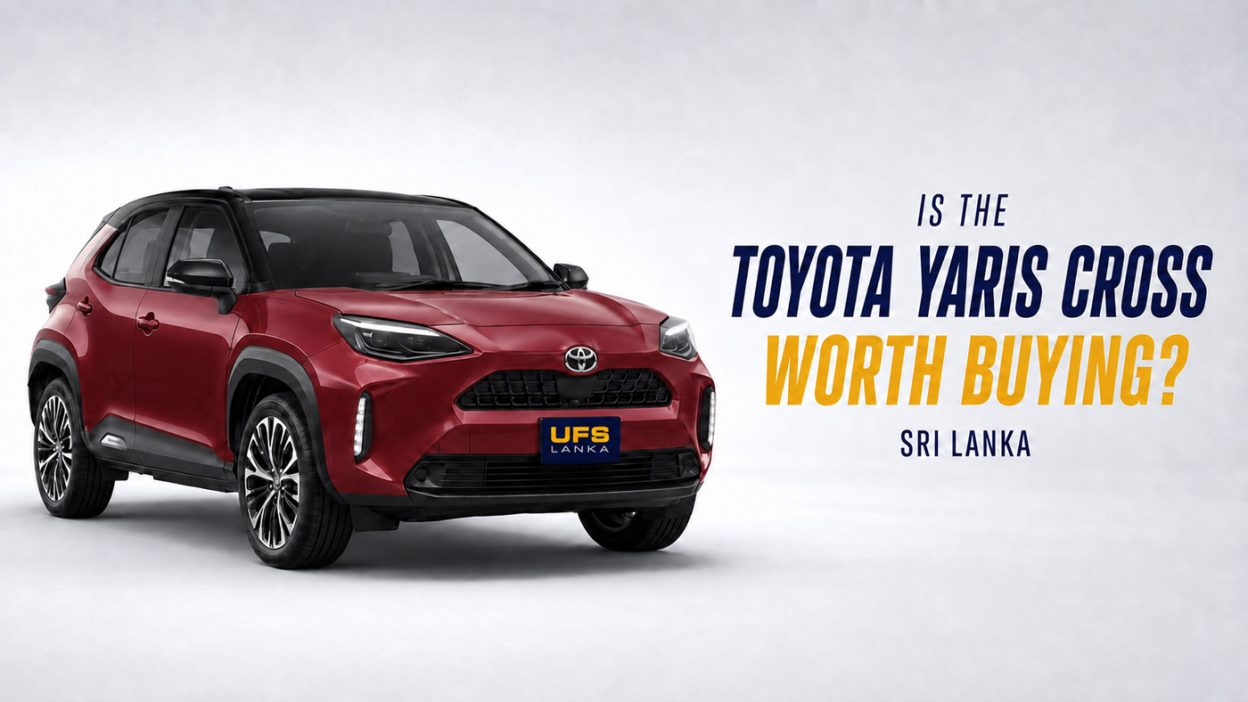
Yes the Toyota Yaris Cross is worth buying in Sri Lanka for the right buyer, particularly in 1.5L hybrid form.
It combines hybrid fuel economy with an elevated driving position, compact dimensions and enough ground clearance for everyday Sri Lankan roads. It is easy to manoeuvre in Colombo, practical for a small family and economical enough for frequent commuting.
Our Quick Verdict
Buy it if: You want excellent fuel economy, easy city driving, useful ground clearance, modern safety features and dependable resale value.
Think twice if: You regularly carry tall adults, need a very large boot, prefer soft suspension or expect powerful SUV performance.
Our preferred choice: A properly inspected, low-mileage Japanese 1.5L Hybrid with verified auction history.
First, Understand Which Toyota Yaris Cross You Are Buying
This is one of the most important points for Sri Lankan buyers because “Toyota Yaris Cross” does not always refer to one identical vehicle.
The Japanese-market Yaris Cross, including the MXPJ10 commonly imported from Japan, uses Toyota’s GA-B platform and a 1.5L three-cylinder hybrid powertrain.
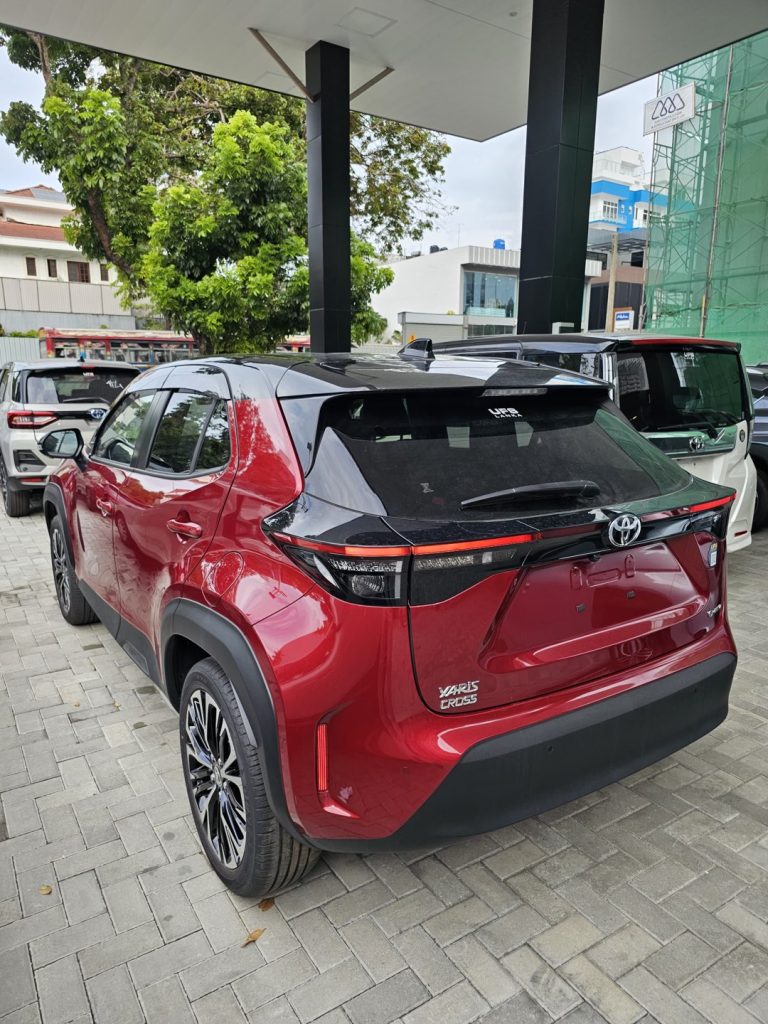
The 2025 Toyota Yaris Cross available through UFS Lanka, for example, is a Japanese-market MXPJ10 1.5L hybrid with 2WD.
By comparison, the Toyota Lanka Yaris Cross page describes a regional model with a 1,496cc four-cylinder engine, a 42-litre fuel tank and a 390-litre luggage compartment.
Engine type, dimensions, ground clearance, luggage capacity and safety equipment can therefore change according to the market, year and grade.
UFS Expert Advice: Never accept a generic specification sheet. Match every claim against the exact chassis code, grade and original documentation of the vehicle you are considering.
Why the 1.5L Hybrid Is Our Preferred Version
For most Sri Lankan buyers, we recommend the 1.5L hybrid over the standard petrol model.
Its main advantage is not dramatic acceleration. It is how naturally the hybrid system suits everyday Sri Lankan driving. The electric motor assists during low-speed movement, while regenerative braking recovers energy when the vehicle slows down.
Power delivery also feels smoother during stop-and-go driving. This makes the hybrid especially suitable for commuters regularly travelling through Colombo, Gampaha and other busy urban areas.
Over several years of ownership, its reduced fuel consumption can offset a meaningful portion of the higher purchase price.
Real-World Toyota Yaris Cross Fuel Economy in Sri Lanka
Toyota’s official Japanese launch information quoted up to 30.8 km/L under the WLTC testing cycle for the Hybrid X 2WD. However, that is a controlled test result—not a guaranteed figure for every Sri Lankan owner.
Colombo Traffic
11-14 km/L
Heavy congestion and frequent idling reduce the hybrid advantage.
Outstation Driving
20-24 km/L
Moderate cruising speeds allow the hybrid system to work efficiently.
Expressway
17-21 km/L
Sustained speeds reduce EV operation and regenerative-braking opportunities.
Under favourable conditions, careful drivers may see approximately 26-27 km/L. That should be considered an excellent result rather than the guaranteed daily average.
Fuel consumption will depend on journey length, traffic severity, driving style, tyre pressure, air-conditioning use and hybrid-battery condition.
Toyota Yaris Cross Price in Sri Lanka
The Toyota Yaris Cross price in Sri Lanka varies according to whether the vehicle is distributor-supplied, imported from Japan, already registered, in transit or purchased through an auction pre-order.
Indicative Sri Lankan Price Guide
- Authorized brand-new petrol model: From approximately LKR 19.95 million
- Authorized brand-new hybrid model: Around LKR 20.75 million
- Reconditioned or direct Japanese import: Approximately LKR 15.4-17.6 million
- Premium low-mileage grades: Up to approximately LKR 21 million
Prices are indicative as of August 2026 and can change with taxes, exchange rates, auction values, freight costs and vehicle availability.
Toyota Lanka’s website currently asks buyers to request the latest price. Obtain a written quotation before comparing an authorized vehicle with a Japanese import.
A Japanese Hybrid Z or GR Sport should not be compared with a lower-grade vehicle based only on its registration year. Mileage, auction grade, optional equipment, accident history and interior condition all affect its real value.
When Does a Japanese Import Represent Good Value?
A verified Japanese hybrid in the LKR 15.4-17.6 million range can offer strong value when it has genuine mileage, a clean auction history and a healthy hybrid system.
The cheapest advertised Toyota Yaris Cross is not automatically the best deal. An unusually low price can hide accident repairs, questionable mileage, a deteriorated hybrid battery, missing documents or charges excluded from the advertised amount.
How the Yaris Cross Handles Sri Lankan Roads
Potholes and Speed Breakers
The Toyota Yaris Cross handles ordinary road imperfections reasonably well. Its raised body provides more useful clearance than a conventional sedan or hatchback, making standard speed breakers, steep entrances and shallow potholes less stressful.
Ground-clearance figures vary significantly by regional version, generally falling between approximately 160 and 210 mm. Confirm the correct measurement for the exact chassis you are buying.
The limitation is its firm suspension. Deep potholes and sharp road edges can send a noticeable thud into the cabin. It is more capable than a low hatchback, but it should not be treated like a full-sized 4×4.
Narrow Streets and Congested Junctions
This is where the Toyota Yaris Cross feels particularly well suited to Sri Lanka. Its compact footprint, light steering and turning radius of approximately 5.2 metres make narrow Colombo lanes and crowded market streets comparatively easy to manage.
The elevated driving position improves forward visibility. Grades equipped with parking sensors, a reversing camera or a panoramic-view monitor are even easier to position in tight parking spaces.
Hill-Country Driving
The 1.5L petrol and hybrid powertrains provide adequate low-speed response for routes towards Kandy, Ella and Nuwara Eliya.
The weakness becomes noticeable during long, steep climbs. When the driver requests sustained acceleration, the e-CVT allows the engine speed to rise and the three-cylinder Japanese engine can sound strained.
Flooding and Rough Rural Roads
The raised ride height provides more confidence through shallow puddles and moderately flooded streets than a normal hatchback. It does not make the Yaris Cross flood-proof.
Deep floodwater must be avoided. The Yaris Cross is not a high-air-intake 4×4, and water can cause severe damage to its engine, electronics and hybrid components.
It can manage maintained estate roads, village lanes and light gravel tracks when driven carefully. Severe ruts, sharp rocks and badly washed-out roads remain beyond the intended use of this urban crossover.
Interior Space and Family Practicality
The Yaris Cross is best considered a small-family crossover rather than a substitute for a large SUV.
Front-seat space, headroom and driving visibility are good. The tall roofline helps the cabin feel less cramped, while the split-folding rear seat makes it easier to carry longer items.
Rear-seat legroom is adequate for children and average-sized adults. Taller adults may find it restrictive during a long journey to Jaffna, Trincomalee or Nuwara Eliya.
Luggage capacity depends on the regional version and grade, but approximately 390 litres is a useful reference for relevant models.
- Weekly grocery shopping
- School bags and children’s equipment
- Several medium-sized suitcases
- A small family’s holiday luggage
If you regularly collect several adults from the airport with large suitcases, the Yaris Cross may quickly feel undersized.
Reliability, Maintenance and Hybrid-Battery Life
Toyota hybrids have established a strong reputation in Sri Lanka through models such as the Aqua and Prius. The Yaris Cross uses newer technology, but the basic ownership principles remain familiar.
Routine maintenance should include oil and filter changes, fluid inspections, brake checks and other scheduled work at approximately 5,000-10,000 km intervals, depending on the manufacturer’s schedule and operating conditions.
Factory hybrid batteries can commonly last around 10-12 years under normal use. However, age alone does not determine battery health.
- Blocked hybrid-battery cooling filters
- Heat accumulation during heavy traffic
- Long periods without driving
- Poor previous maintenance
- Incorrect battery repairs or unmatched replacement cells
Common service items such as filters, brake components and suspension bushes are increasingly accessible. Specialized inverter components, electronic modules, sensors and model-specific trim may require dealer ordering or sourcing from Japan.
Should the Hybrid Battery Be Opened and Cleaned Regularly?
We do not recommend unnecessary battery-pack disassembly simply because a workshop markets it as routine maintenance.
Keeping the cooling intake and fan path clean is important. However, opening a healthy high-voltage battery without a genuine diagnostic reason can introduce additional risk.
Begin with a proper diagnostic scan and temperature or voltage assessment. Internal battery work should only be completed by a qualified hybrid specialist using suitable safety procedures.
What to Check Before Buying a Reconditioned Yaris Cross
A shiny exterior and low odometer reading are not enough. Before recommending a Japanese import, we verify the vehicle’s identity and history using its original documentation.
Essential Documents
- Japanese Export Certificate: Confirms deregistration details, manufacturing information and recorded mileage.
- Original auction sheet: Shows exterior and interior grades, damage markings and auction remarks.
- Pre-shipment inspection certificate: Confirm that the required certificate is authentic and issued by an accepted inspection agency such as JAAI or JEVIC, where applicable.
- Customs declaration and invoice: Help verify lawful importation, tax assessment and port clearance.
The chassis number on the vehicle must match the Export Certificate, auction sheet, inspection certificate and customs documents. This comparison can expose substituted auction sheets, altered mileage or an incorrectly represented vehicle.
Physical and Electronic Inspection
- Scan the hybrid battery for cell-voltage deviation and diagnostic trouble codes.
- Inspect the underbody, suspension bushes and chassis for damage or rust.
- Use a paint-depth gauge to identify repainted body panels.
- Look for structural repairs, flood exposure and water damage.
- Test Toyota Safety Sense cameras, radar and warning systems.
- Check the parking sensors, cameras, infotainment and grade-specific equipment.
Do not reject a vehicle simply because one panel has been repainted. The important question is whether the repair agrees with the auction sheet and whether any structural damage was concealed.
A Real UFS Toyota Yaris Cross Example
The UFS Auto stock example BLK0604032 demonstrates why buyers should assess a specific vehicle rather than relying on a generic advertisement.
- Year: 2025
- Chassis: MXPJ10-2084189
- Engine: 1.5L Hybrid
- Transmission: Automatic
- Drive: 2WD
- Mileage: Approximately 2,400 km
- Colour: Red
The chassis and published details provide a clear starting point for checking the Export Certificate, auction history, equipment and physical vehicle.
UFS has also shared a real Toyota Yaris Cross customer experience, giving potential buyers a practical reference beyond brochure specifications.
Toyota Yaris Cross vs Honda Vezel
The Honda Vezel is the more spacious choice. It generally provides better rear-seat accommodation and more flexibility for families frequently carrying adult passengers.
The Yaris Cross is our preferred option for buyers prioritizing fuel economy, compact dimensions, straightforward long-term ownership and Toyota’s strong Sri Lankan resale demand.
Buyers considering the Honda should read our Honda Vezel Sri Lanka Import Guide.
Toyota Yaris Cross vs Toyota Raize
The Toyota Raize is smaller, easier to park and normally less expensive. It is a sensible choice for a budget-conscious urban driver who does not require the additional refinement of the Yaris Cross.
The Yaris Cross feels more substantial and premium. It also offers more sophisticated hybrid technology and, depending on the grade, more advanced driver-assistance equipment.
See our Toyota Raize Hybrid review for a closer comparison.
Toyota Yaris Cross vs Suzuki Fronx
The Suzuki Fronx has a lower entry price and should generally be less expensive to maintain. That matters for buyers focused primarily on affordability.
The Yaris Cross counters with a more solid road presence, sophisticated hybrid technology and stronger perceived build quality. Its Toyota badge may also help when it is time to resell.
Read our 2026 Suzuki Fronx Sri Lanka review to see where the Fronx offers better value.
Who Should Buy the Toyota Yaris Cross?
- Urban and suburban commuters travelling through heavy traffic
- Small families with one or two children
- Drivers who need more clearance than a conventional hatchback
- Owners who value fuel economy, safety and resale demand
- People who want an SUV-style driving position without a large vehicle
- Long-term owners prepared to maintain the hybrid system correctly
Who Should Avoid It?
- Large families regularly carrying adult passengers
- Buyers needing a large boot for frequent airport transfers
- Drivers seeking the lowest possible purchase price
- Anyone expecting soft, luxury-car ride comfort
- Drivers frequently travelling through deep floods or severe terrain
- Enthusiasts seeking strong acceleration and sporty handling
Authorized Brand-New or Verified Japanese Import?
An authorized brand-new Toyota Lanka unit is the safer choice for someone who values a manufacturer-backed warranty, predictable after-sales support and the convenience of dealing with an official local distributor.
A verified Japanese import can provide better value and access to desirable grades such as the Hybrid Z or GR Sport. The saving is worthwhile only when the auction sheet, mileage, hybrid health, inspection certificate and customs documentation are independently verified.
Personally, we would choose a clean, low-mileage Japanese 1.5L hybrid when its history is transparent and the price difference is meaningful. For someone who wants maximum peace of mind and does not mind paying more, the authorized unit remains the logical route.
Final Verdict: Is the Toyota Yaris Cross Worth Buying in Sri Lanka?
Yes. The Toyota Yaris Cross is one of the most sensible compact crossovers for Sri Lankan urban and suburban driving.
Its strengths are relevant to real local conditions: excellent fuel economy, compact dimensions, useful ground clearance, modern safety equipment and healthy resale demand.
Its rear legroom, firm ride and engine noise should not be ignored. However, if you buy the correct version at the correct price—and verify its history properly—the Yaris Cross is a practical long-term ownership choice rather than simply a fashionable compact SUV.
Frequently Asked Questions
What is the Toyota Yaris Cross price in Sri Lanka?
As of August 2026, Japanese imports commonly fall around LKR 15.4-17.6 million, while authorized brand-new versions are approximately LKR 19.95-20.75 million. Premium low-mileage grades may reach approximately LKR 21 million.
Is the Yaris Cross hybrid fuel-efficient in Colombo?
Approximately 11-14 km/L is a realistic planning range for severe Colombo traffic. Higher figures are possible in lighter traffic, while short journeys and prolonged idling can reduce efficiency.
Is the Toyota Yaris Cross suitable for Sri Lankan roads?
Yes, for normal urban, suburban and maintained rural roads. It handles speed breakers, moderate potholes and shallow puddles better than a low hatchback. It is not intended for deep flooding or serious off-road use.
Is the Yaris Cross spacious enough for a family?
It is practical for a small family with one or two children. Taller adult passengers may find the rear legroom restrictive on long journeys.
How long should a Yaris Cross hybrid battery last?
A factory hybrid battery can commonly last around 10-12 years under normal conditions. Actual battery life depends on heat exposure, cooling-system cleanliness, usage patterns and maintenance history.
Looking for a Toyota Yaris Cross in Sri Lanka?
Check current availability, request the latest Toyota Yaris Cross price in Sri Lanka or get professional assistance importing a verified Japanese vehicle.
WhatsApp: +94 77 316 6518
Visit: No. 12, Alfred Place, Colombo 03
Prices and specifications were reviewed in August 2026 and may change. Confirm the exact chassis, grade, equipment, warranty and final on-road price before purchasing.