

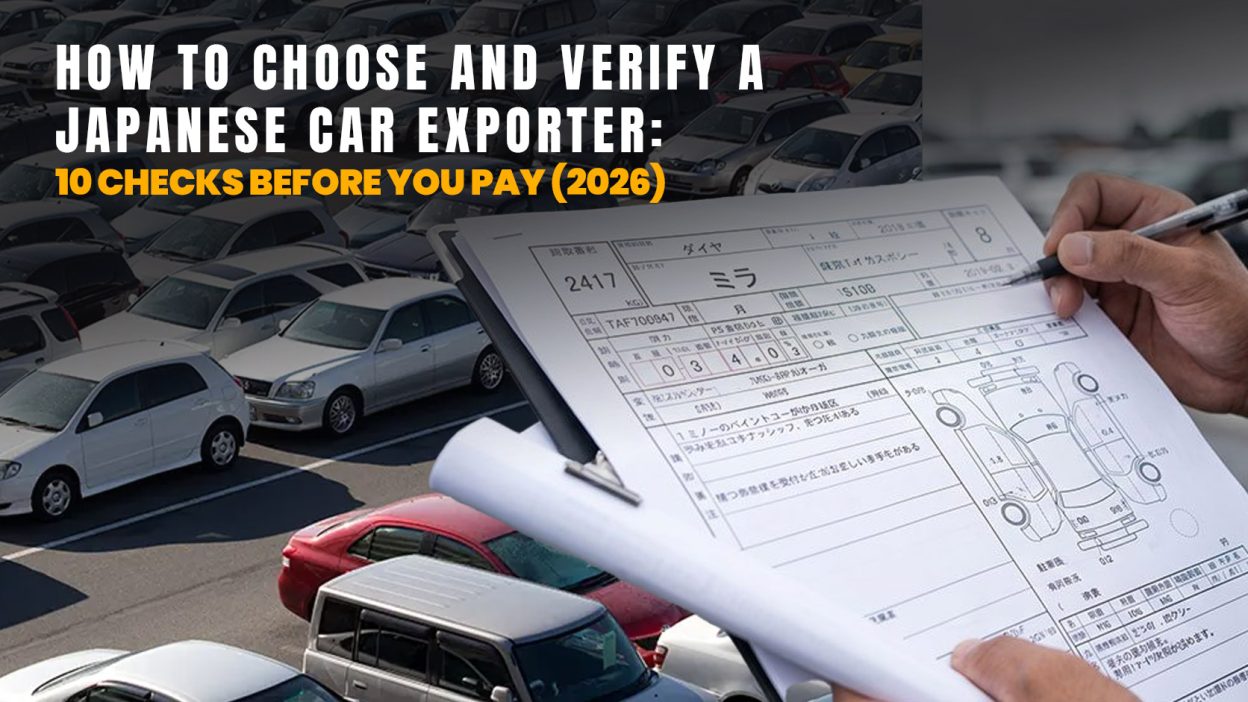
Short answer: Before you send money to a Japanese car exporter, check five things: the company appears on Japan’s free Corporate Number Publication Site with the same name and address it gives you; it holds a secondhand dealer licence (kobutsusho) from a Japanese police Public Safety Commission; it is a JUMVEA member or can explain why not; it sends the original auction sheet and, after purchase, the Japanese export certificate with a chassis number that matches the car; and its bank account is in the company’s own name in Japan. If any of these fail, do not pay.
Every month someone messages us with the same story. They found a clean Toyota at a price that looked too good, paid a “Japanese exporter” they met on social media, and then the car, the documents and the seller all disappeared. The car usually never existed. The photos were lifted from a real exporter’s website.
Japan’s used car export trade is one of the most trustworthy in the world, but the money moves across borders and the buyer rarely meets the seller. That gap is where scammers work. The Embassy of Japan in Tanzania has said it receives many reports of problems with used cars bought online from companies claiming to be in Japan, and it cannot step into commercial disputes. Once the money is gone, it is usually gone.
The good news: Japan publishes most of what you need to check, for free, in English. This guide walks through the checks we would run ourselves if we were buying from someone we had never met. It applies whether you are importing to Sri Lanka, Zimbabwe, Botswana, Kenya, Tanzania, Jamaica, the Philippines or anywhere else that takes Japanese used cars.
The 10 checks at a glance
| # | Check | Where to do it | Red flag |
|---|---|---|---|
| 1 | Company is registered in Japan | Corporate Number Publication Site | Name or address doesn’t match, or no result at all |
| 2 | Holds a secondhand dealer licence (kobutsusho) | Company website footer or “company profile” page | No licence number, or they don’t know what it is |
| 3 | Industry association membership | JUMVEA member list | Claims membership but isn’t on the list |
| 4 | Real address and staff in Japan | Google Maps, a video call from the office or yard | Only a mobile number and a free email address |
| 5 | Original auction sheet for the exact car | Ask the exporter | Refuses, or the sheet’s chassis number differs |
| 6 | Inspection certificate if your country needs it | JEVIC, JAAI or your country’s approved agency | “Certificate” arrives as an unverifiable image only |
| 7 | Pro forma invoice from the company | Company letterhead, Japanese address, corporate details | Invoice from a person, not a company |
| 8 | Bank account in the company’s name in Japan | The invoice and the bank details | Personal account, third country, crypto or money transfer app |
| 9 | Export certificate after purchase | Scan before shipping, original with your documents | Chassis number or dates don’t match |
| 10 | Track record you can test | Reviews, local agents, past buyers in your country | Only testimonials on its own site, all from new accounts |
1. Check the company is registered in Japan
Every company in Japan has a 13-digit Corporate Number issued by the National Tax Agency. The Corporate Number Publication Site is free, needs no account and has an English version. Search the company name, or the number if they give it to you.
What you are looking for is a match. The registered name and head office address should be the same as the ones on the exporter’s website and invoice. If a company says it is in Yokohama and the registry says Osaka, or the company simply isn’t there, stop and ask why. For more detail such as founding date and capital, the government’s gBizINFO database is also free.
One caution: scammers sometimes borrow the name of a real Japanese company. A match proves the company exists, not that you are talking to it. That is why the next checks matter.
2. Ask for the secondhand dealer licence number
Under Japan’s Secondhand Goods Business Act, anyone who buys and sells used goods as a business needs a permit from the Prefectural Public Safety Commission, which in practice means the local police. That includes used cars bought in Japan and sold overseas. In Japanese this licence is called kobutsusho kyoka (古物商許可).
Legitimate exporters usually show the licence number in their website footer or company profile, in the format “[Prefecture] Public Safety Commission, Permit No. …”. Ask for it. A real exporter will send it in seconds. Someone who doesn’t recognise the term is not operating a licensed used car business in Japan.
3. Check JUMVEA membership
The Japan Used Motor Vehicle Exporters Association (JUMVEA) is the main trade body for used car exporters. It began in 1995, publishes a list of its members and runs a payment protection scheme called JUMVEA Safe Trade (JUST), in which your payment is held by the association rather than sent straight to the seller.
In Kenya, JETRO Nairobi and the Embassy of Japan have recommended buying through JUMVEA members to protect buyers’ money. Two honest caveats: the Embassy of Japan in Tanzania notes it cannot guarantee every listed member, and plenty of genuine exporters are not members. Treat membership as a strong positive, not the only test. If a company claims membership, check the list on jumvea.or.jp yourself rather than trusting a logo on its website.
4. Confirm a real office, yard and people
Look the address up on Google Maps and Street View. Is it an office building, a yard full of cars, or a residential flat? Then ask for a short video call with someone in Japan who can show the car or the yard. Exporters who handle hundreds of cars a month do this routinely.
Warning signs include a website registered a few weeks ago, only a WhatsApp number with a foreign country code, a free email address instead of a company domain, and staff who won’t give a full name.
5. Get the original auction sheet
Most used cars exported from Japan are bought at dealer auctions, and every auction car has an inspection sheet with a grade, mileage, chassis number and a map of scratches and dents. A trustworthy exporter sends you the original sheet for the exact car before you pay.
Check that the chassis number on the sheet matches the photos and the invoice. Grades of 4 and above with an interior grade of B or better are usually a safe starting point; R or RA means accident repair. Our guide on how to read an auction sheet explains every symbol.
6. Confirm the inspection certificate your country requires
Many importing countries require a pre-shipment inspection in Japan, covering mileage, roadworthiness and radiation. Sri Lanka, Kenya, Tanzania and others name specific agencies. Ask which inspection your country needs and who will carry it out, and make sure the certificate number can be checked with the issuing body.
See our guides to the JEVIC certificate and the JAAI certificate for Sri Lanka.
7 and 8. Read the invoice, then check who you are paying
Most car export scams end at the payment step, so slow down here. The pro forma invoice should come from the company, on its letterhead, with its Japanese address and contact details, the car’s chassis number, the price terms (FOB, CFR or CIF) and the destination port.
Then look at the bank details. The account should be held by the company, in Japan, in the company’s own name. Do not pay:
- into a personal account, even if they say it is “the director’s account”
- to a bank in a third country “for faster processing”
- by cryptocurrency, gift cards or a money transfer app
- a “customs clearance” or “release” fee demanded after the car has supposedly shipped
If you can, use a protected method such as JUMVEA’s JUST scheme, or pay a deposit first and the balance once documents are verified. A late change to bank details, usually by email, is one of the most common frauds. Always confirm a change by phone with a number you already trust.
9. Check the export certificate before the car sails
When a car leaves Japan, its Japanese registration is cancelled and an export certificate is issued. It is the closest thing to a title document for an exported car: it records the chassis number, model code, first registration date and the registration history, and many countries need the original to register the car. New Zealand, for example, asks for the original export certificate for used passenger vehicles from Japan.
Ask for a scan before shipping and compare the chassis number with the auction sheet, invoice and photos. All four should match exactly. The original is then posted to you or sent with the shipping documents, together with the bill of lading.
10. Test the track record
Reviews on an exporter’s own website prove little. Look for evidence you can test: reviews on independent platforms over several years, a local agent or office in your country, and buyers you can actually speak to. Ask the exporter how many cars it shipped to your country last year and which port it uses. A company that ships regularly will answer immediately.
Common car export scams and how to spot them
| Scam | How it works | How to spot it |
|---|---|---|
| Cloned website | A copy of a real exporter’s site with different bank details and phone numbers | Domain registered recently; phone and email differ from the company’s registry details |
| Too-cheap car | A popular model listed far below auction prices to rush you | Price well under similar cars elsewhere; pressure to pay “today” |
| Fake shipping fee | After payment, extra “customs”, “insurance” or “release” fees appear | Fees not on the original invoice; payment again to a new account |
| Switched bank details | An email, often from a hacked or look-alike address, says the account has changed | Any late change of bank details; verify by phone |
| Wrong car shipped | Different chassis number, lower grade or higher mileage than promised | Chassis number on export certificate doesn’t match the auction sheet |
Choosing between genuine exporters
Once a company passes the checks, the choice comes down to service. Compare:
- Auction access: can they bid for you at major auctions, or do they only sell their own stock?
- Transparency: do they share the auction sheet, photos and total landed cost before you commit?
- Your country: do they know your import rules, age limits and inspection requirements?
- Local support: is there an office or agent at your end who can help with clearing and registration?
- Communication: do they reply clearly, in writing, and keep you updated through shipping?
For background on how the trade works, see our guide to Japanese second-hand car dealers and how cars travel from auction to Africa.
How UFS Auto works with buyers
UFS Auto sources vehicles in Japan and supports buyers through its own teams in Sri Lanka (UFS Lanka), South Africa, Zimbabwe, Tanzania and Mozambique. We share the auction sheet and photos before you buy, explain the inspection your country requires, and walk you through the full landed cost. We encourage every buyer to run the checks in this guide on us too.
Talk to our Japan team on WhatsApp at +81 80 2982 0578, or find your local office and country guide on the Guides by Country page.
Choosing a Japanese car exporter: Frequently Asked Questions
How do I choose a reliable Japanese car exporter?
Check that the company is on Japan’s Corporate Number Publication Site with the same name and address, holds a secondhand dealer licence (kobutsusho), is a JUMVEA member or has a long, testable track record, shares the original auction sheet, issues an invoice from the company and takes payment only into a company bank account in Japan.
How can I verify a Japanese car exporter is real?
Search the company on the National Tax Agency’s free Corporate Number Publication Site, ask for its secondhand dealer licence number, check the JUMVEA member list if it claims membership, confirm the address on Google Maps and ask for a video call from the office or yard.
What is JUMVEA?
The Japan Used Motor Vehicle Exporters Association, a trade body for used car exporters founded in 1995. It publishes a member list and runs JUMVEA Safe Trade (JUST), a scheme in which the buyer’s payment is held by the association rather than paid straight to the seller.
Is it safe to buy a car from Japan online?
Yes, if you deal with a verified, licensed exporter and pay a company account in Japan. Most problems come from fake sellers on social media, cloned websites and changed bank details, not from established exporters.
What documents should a Japanese exporter give me?
Before payment: the auction sheet, photos and a pro forma invoice from the company. After purchase: the export certificate, any inspection certificate your country requires, the commercial invoice and the bill of lading.
Should I pay a car exporter through a personal bank account?
No. Pay only into an account held in the company’s own name in Japan. Personal accounts, third-country banks, cryptocurrency and late changes of bank details are all common signs of fraud.
Sources: National Tax Agency Corporate Number Publication Site; Secondhand Goods Business Act (Japanese Law Translation); Embassy of Japan in Tanzania, notice on online used car purchases; JETRO Nairobi, JUMVEA caution; NZTA, used vehicles from Japan. Last checked 13 November 2026. This guide is general information; always confirm import rules with your own customs authority.