
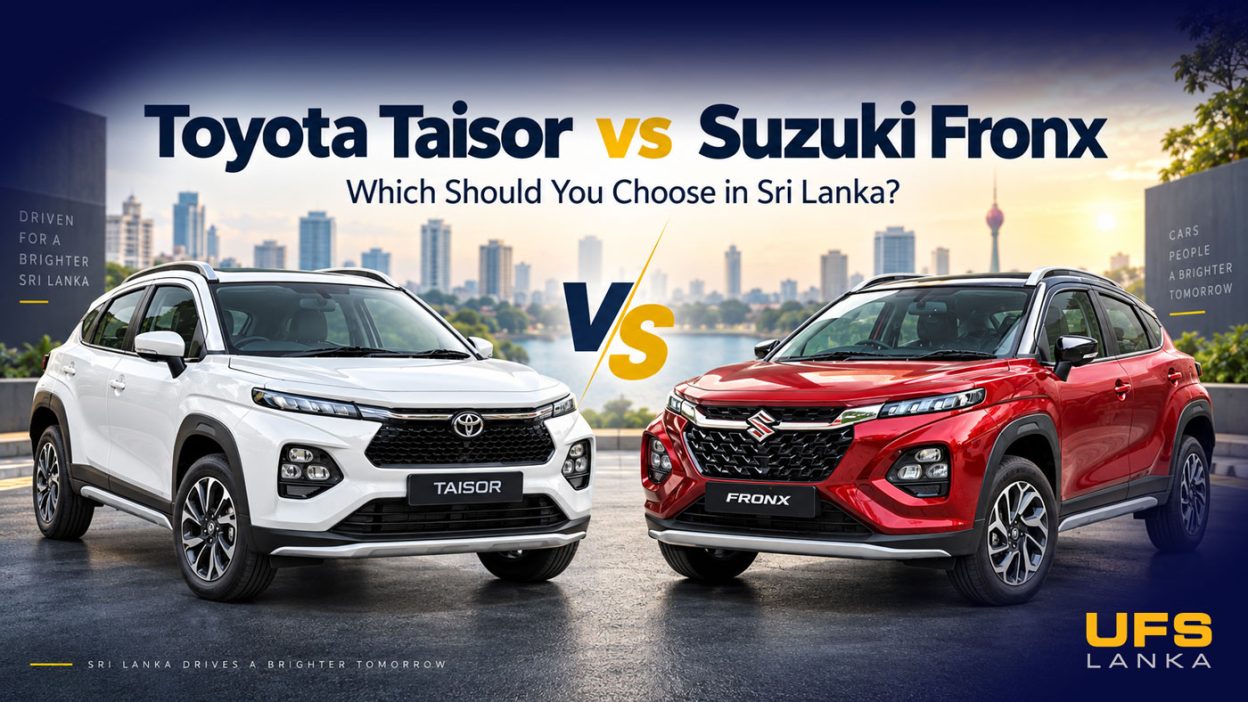
If you are comparing the 2026 Toyota Urban Cruiser Taisor V Grade 1.0-litre turbo with the 2026 Suzuki Fronx Alpha 1.0-litre turbo, the honest answer is that you are not choosing between two fundamentally different vehicles. You are choosing between two closely related versions of the same basic compact crossover.
They share their Suzuki HEARTECT platform, 998cc three-cylinder Boosterjet turbo-petrol engine, mild-hybrid assistance and six-speed torque-converter automatic transmission. Their performance, fuel economy, cabin space and core ownership requirements are therefore extremely similar.
My short answer for a Sri Lankan buyer is this: choose the Suzuki Fronx Alpha if your priority is obtaining the strongest equipment-to-price value today. Choose the Toyota Taisor V Grade if you are prepared to pay a little more for the Toyota badge and its potential advantage in resale demand.
If I were spending my own money, I would choose the Toyota Taisor V Grade. My reason is not that it is mechanically superior. It is the possibility of stronger long-term financial preservation in Sri Lanka, where Toyota-badged vehicles have historically attracted broad used-market demand and often sell faster.
Why Are the Toyota Taisor and Suzuki Fronx So Similar?
The Taisor is Toyota’s version of the Fronx, developed through the Toyota-Suzuki partnership. This is badge engineering: the two vehicles share the expensive engineering underneath, while their brands, exterior details, grade names and sales channels differ.
For this comparison, the fairest match is the 2026 Taisor V Grade 1.0 Turbo Automatic against the 2026 Fronx Alpha 1.0 Turbo Automatic. Both are high-grade versions aimed at buyers who want the full technology package rather than a basic entry model.
Both use a 1.0-litre three-cylinder turbo engine producing approximately 100 PS and 147.6 Nm, paired with a six-speed torque-converter automatic. Toyota’s official Taisor brochure also lists paddle shifters and a certified 19.86 km/L figure for the turbo automatic under test conditions. Those laboratory figures are useful for comparison, but they should not be treated as a promise of everyday Sri Lankan mileage.
Country specifications can differ. Before buying, confirm the engine, transmission, safety equipment and feature list against the actual chassis number. Do not rely only on an international advertisement or the badge on the tailgate.
Which One Is Better to Drive?
In normal use, there is very little meaningful difference. The same light platform, turbo engine and automatic gearbox give both vehicles a similar personality.
Acceleration and overtaking
The turbo engine delivers its strongest response in the low-to-mid rev range. That makes both vehicles feel lively when joining traffic or overtaking slower vehicles on single-lane roads. Neither is a performance SUV, but both have enough mid-range punch for their size and weight.
There can be a short delay at very low engine speeds before the turbo builds boost. Once it does, acceleration feels brisk. Drivers moving from a naturally aspirated small car will notice the stronger mid-range response, but they may also need time to adjust to the less linear throttle delivery.
Gearbox smoothness
The six-speed torque-converter automatic is one of the strongest reasons to choose these turbo variants. It is generally smoother and more natural in slow traffic than a basic automated manual transmission. Paddle shifters also give the driver more control when overtaking or descending hills.
Ride and handling
Both feel more like slightly raised, well-planted hatchbacks than traditional SUVs. They are easy to position in Colombo traffic, simple to park and stable at expressway speeds. Body roll is reasonably controlled, while the steering is light enough for daily urban use.
The trade-off is a firm low-speed ride. Sharp potholes and broken road edges can enter the cabin more clearly than buyers may expect from the SUV-inspired appearance. The ride settles as speed increases and feels better on smoother outstation roads and expressways.
Cabin noise
Both share the normal sound characteristics of a small three-cylinder turbo engine. A mild vibration or thrum can be noticed at idle, and the engine note becomes coarse when pushed hard. Any perceived refinement difference between two individual vehicles may come from tyres, tyre pressures, road surface or build variation rather than a major mechanical advantage for either badge.
Real-World Fuel Economy in Sri Lanka
Based on owner feedback and practical Sri Lankan use, a realistic expectation for either 1.0-litre turbo automatic is approximately:
- 10 to 15 km/L in heavy city traffic
- 18 to 23 km/L on open roads and expressways
Around 18 km/L is a reasonable result in suitable mixed or open-road use, but city consumption can fall sharply with long idling, short journeys, aggressive acceleration, heavy loads and continuous air-conditioning. The Taisor should not be expected to use less fuel merely because it carries a Toyota badge; equivalent Taisor and Fronx powertrains should return closely aligned figures.
Features, Safety and Interior Quality
The high-grade Taisor V and Fronx Alpha broadly overlap in the equipment buyers care about most. The Suzuki Sri Lanka Fronx page also shows why exact local specifications matter, because listed equipment and technical details can vary by grade. Depending on the exact import specification, these features may include:
- Six airbags
- ABS with electronic brake-force distribution
- Vehicle stability control and hill-hold assistance
- A 360-degree camera
- A head-up display
- A 9-inch touchscreen infotainment system
- Wireless Apple CarPlay and Android Auto
- Wireless phone charging
- Automatic climate control and rear air vents
- Cruise control and paddle shifters
- ISOFIX child-seat mountings
On equipment alone, there is rarely enough separation to justify choosing one without looking at price, warranty and import source. Inspect the actual vehicle because features may change by country, production batch and grade.
The cabins are also extremely similar. Their layouts are practical and modern, but they do not feel genuinely luxurious. Hard plastics are used widely, and some panels and switches feel light. Buyers paying more for the Taisor should understand that the Toyota badge does not transform the underlying Suzuki-designed interior into a higher-class cabin.
Space and Family Practicality
Both vehicles suit a couple, a small family or a daily commuter who wants a compact footprint with a raised seating position. They are easy to use in congested areas such as Colombo, Dehiwala, Wellawatte, Nugegoda and Kandy.
The coupe-like roofline creates the styling appeal, but it also brings compromises. Rear legroom and headroom can feel tight for taller adults on long journeys. The boot is adequate for groceries, work bags and normal weekend use, but it is not as useful as the luggage area in a boxier compact SUV.
If you regularly carry five adults, large suitcases or bulky family equipment, test the rear seat and load area before paying a deposit. The exterior styling can make these vehicles look larger and more SUV-like than they feel inside.
Toyota Taisor vs Suzuki Fronx Price in Sri Lanka
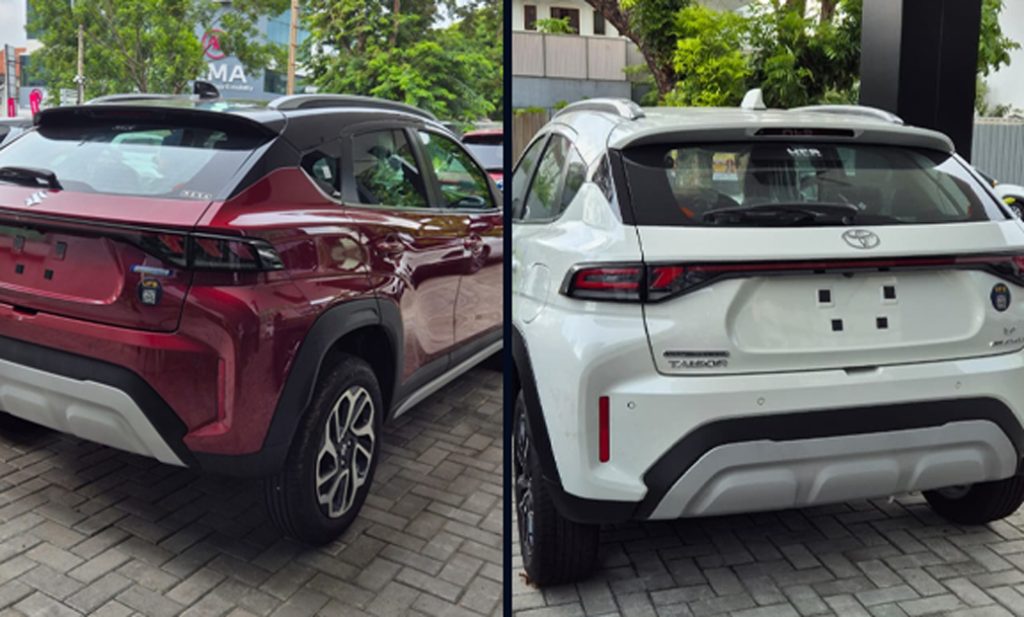
At the time of this comparison in August 2026, market asking prices were approximately Rs. 11.6 million to Rs. 12.4 million for a 2026 Toyota Taisor V Grade, while a 2026 Suzuki Fronx Alpha was commonly positioned around Rs. 11.35 million to Rs. 11.65 million.
These are market guides, not permanent fixed prices. The final amount can change according to colour, exact specification, warranty, registration status, exchange rates, taxes, importer margin and whether the vehicle is ready stock or arriving later.
Which offers better value for money?
The Suzuki Fronx Alpha is the rational value winner when it is meaningfully cheaper. It gives you essentially the same powertrain, platform, safety package, technology and cabin for less money. A buyer focused on the first purchase price should find it difficult to justify a large Taisor premium.
The Taisor’s value argument appears later. Sri Lankan buyers have historically shown strong confidence in the Toyota name, and that can support wider demand, faster resale and a stronger used-market price. This is a market-perception advantage, not proof of better engineering, and no future resale figure can be guaranteed.
My practical rule is simple: if the price gap is small and you expect to resell the vehicle, I would lean towards the Taisor. If the gap becomes large, the Fronx is the smarter purchase because you are paying less for almost the same vehicle.
Warranty, Servicing and Spare Parts
This is where buyers need to separate the badge from the support package.
A Taisor imported independently does not automatically receive comprehensive Toyota Lanka agent backing simply because it has Toyota emblems. Many units are sourced from India through independent importers. Their warranty is normally provided by the selling importer or dealer and is governed by that company’s written terms.
Some importer packages are advertised at around three years or 100,000 km, while other sellers may offer different periods or extended coverage. Never assume the warranty. Ask for a written document stating:
- Who is legally responsible for the warranty
- The time and mileage limits
- Which engine, turbo, transmission, hybrid and electrical components are covered
- Required service intervals and approved service locations
- Excluded wear items and claim conditions
- Whether the warranty can transfer to the next owner
The shared Suzuki hardware can be an ownership advantage because routine mechanical parts should have wider commonality than those of a low-volume standalone model. However, body panels, lamps, grilles, badges and some electronic or trim components can remain model-specific.
Suzuki buyers may also value the established local Suzuki service network. Taisor buyers should compare the independent importer’s after-sales ability rather than relying on the Toyota name alone.
What Our UFS Lanka Inventory Shows
A useful real-market example is UFS stock ILK0606011, a brand-new 2026 Suzuki Fronx Alpha Smart Hybrid with a 998cc engine, automatic transmission, 2WD and zero recorded kilometres. That unit was sold, supporting the view that Sri Lankan buyers see the Fronx as a strong value proposition.
Customer discussions around the Fronx commonly focus on its near-identical interior and driving experience compared with the Taisor, together with fuel economy around 18 km/L in suitable conditions. The lesson is that buyers are willing to choose the Suzuki badge when the price saving is clear.
At the same time, UFS Lanka continues to carry multiple 2026 Toyota Taisor V Grade Neo Drive units. That demand reflects a different priority: buyers who want the shared Fronx engineering but place greater weight on Toyota’s resale perception.
Common Weaknesses You Should Accept Before Buying
Because the vehicles share their platform and powertrain, their core drawbacks are also shared:
- Rear space can feel cramped for tall adults.
- The boot is modest compared with boxier compact SUVs.
- The suspension can feel firm over potholes at low speeds.
- The three-cylinder engine is audible and slightly rough when revved hard.
- Cabin materials include a large amount of hard plastic.
- There can be noticeable turbo lag at very low rpm.
- The turbo and mild-hybrid systems require correct, timely maintenance.
None of these points automatically makes either vehicle a poor purchase. They simply show why a test drive matters. A buyer expecting the space, ride comfort and material quality of a larger SUV may be disappointed, while someone moving from a small hatchback may find both vehicles well-equipped and easy to live with.
Who Should Choose the Toyota Taisor?
Choose the Taisor V Grade if:
- You intend to protect resale demand as much as possible.
- You believe the Toyota badge will make the vehicle easier to sell later.
- The price gap over an equivalent Fronx is relatively small.
- You want a practical daily crossover with familiar shared mechanical parts.
- Your importer provides a clear and credible written warranty.
Who Should Choose the Suzuki Fronx?
Choose the Fronx Alpha if:
- You want the strongest value at the time of purchase.
- You prefer Suzuki’s sportier grille and more individual styling.
- You want similar performance and equipment without paying a badge premium.
- You value access to an established local Suzuki support network.
- You plan to keep the vehicle long enough that the initial saving matters more than short-term resale.
Which Buyers Should Consider Neither?
Neither model is ideal if you frequently carry tall adults in the rear, require a large boot, expect a soft ride over badly broken roads or want the refinement of a four-cylinder engine. Buyers who regularly travel with five adults and substantial luggage should compare a larger, more upright vehicle before deciding.
Final Verdict: Taisor for Resale Confidence, Fronx for Immediate Value
There is no honest way to claim that the Toyota Taisor V Grade is dramatically better engineered than the Suzuki Fronx Alpha. In the versions compared here, they are mechanical twins with nearly identical performance, fuel economy, space, features and weaknesses.
The Fronx is the better value-for-money choice. The Taisor is the stronger choice for a buyer who accepts a reasonable premium in exchange for the Toyota badge’s potential resale advantage in Sri Lanka.
My own choice would be the Taisor because I place greater weight on long-term financial preservation and resale turnaround. I would switch to the Fronx if the Taisor premium became too large or if the Suzuki came with a clearly stronger official after-sales and warranty package.
Before paying a deposit, compare the two actual vehicles chassis by chassis. Verify their production specification, safety equipment, warranty provider, service conditions and final registered price. On this comparison, the paperwork and price gap matter more than the badge-engineered hardware.
You can browse current Toyota Taisor stock at UFS Lanka and review the sold 2026 Suzuki Fronx Alpha Smart Hybrid example. For current availability, exact specifications and updated Sri Lankan pricing, contact UFS Lanka on WhatsApp at +94 77 316 6518.