


If you have been comparing compact Japanese vans, CIF quotations and local vehicle prices, you have probably already noticed growing interest in the 2026 Suzuki Every DA18V. However, choosing the vehicle is only one part of the decision; you must also understand ownership, documentation, shipping, Customs duties and registration.
In this guide, you will learn how to personally import a 2026 Suzuki Every to Sri Lanka, how importing under your name works, what a CIF quotation should contain and which details to verify before making a payment.
Key Takeaways
- Personal import gives the customer greater control over the selected vehicle, grade, colour, equipment and supporting documentation.
- The DA18V chassis code helps distinguish the latest updated Suzuki Every from earlier DA17V models.
- CIF pricing normally covers the vehicle cost, marine insurance and freight, but not every Sri Lankan tax or clearance expense.
- The final landed cost depends on Customs classification, applicable taxes, exchange rates, port expenses, registration and local service charges.
- The buyer’s name and chassis details should match across the invoice, shipping documents and agreed import arrangement.
- Current import eligibility should be confirmed before payment because tariffs, age limits, licences and classification requirements can change.
- UFS Lanka support can connect vehicle sourcing in Japan with shipping, documentation and Sri Lankan customer guidance.
What Is a Suzuki Every Personal Import to Sri Lanka?
A Suzuki Every personal import is a purchase arrangement in which a vehicle is selected and imported specifically for an individual customer rather than first being imported as general dealer stock.
Under a properly structured personal import, the buyer chooses the vehicle and receives documentation connected to that specific purchase. The exact importer, consignee, payment and registration arrangement must still comply with current Sri Lankan banking, Customs and Department of Motor Traffic requirements.
Personal import does not mean avoiding taxes or importing without regulation. It means the transaction is organised around a named customer instead of the customer buying a vehicle that a dealer has already imported and registered.
For example, a customer may request:
- A 2026 Suzuki Every with a specific chassis code
- A preferred PA, PC, JOIN or JOIN Turbo grade
- Two-wheel drive or four-wheel drive
- Automatic CVT or manual transmission
- A preferred exterior colour
- Selected safety and convenience equipment
- A complete CIF quotation to Sri Lanka
The customer reviews the specification and quotation before authorising the purchase. The exporter then coordinates the agreed Japan-side documentation and shipping process.
Buyers who want to understand the broader purchasing route can also review the UFS guide to importing Japanese cars to Sri Lanka.
A personal import gives the buyer control over the vehicle before it enters Sri Lanka.
Why Does Importing a Suzuki Every Under Your Name Matter?
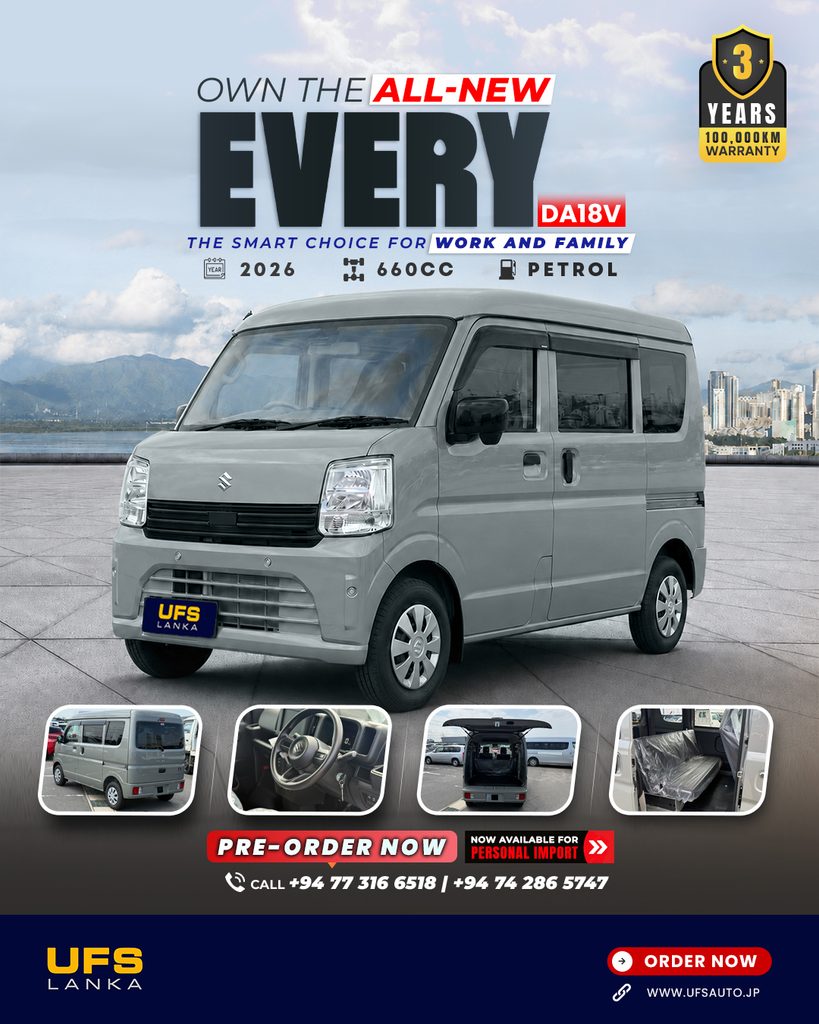
Importing a Suzuki Every under your name matters because it creates a clearer connection between the customer, the selected vehicle and the supporting purchase documents.
A ready-stock vehicle offers speed and convenience, but the dealer normally chooses the colour, grade and specification before the customer becomes involved. Personal import allows you to start with your own requirements.
You have more control over the specification
Personal import lets you identify what you need before the vehicle is purchased. This matters because Suzuki Every grades can differ significantly in comfort, safety, transmission and convenience features.
For example, a small-business owner may prioritise cargo practicality and purchase cost, while a family buyer may prefer better rear seating, power windows, keyless access and additional safety technology.
You can review the cost structure earlier
A transparent personal-import quotation separates the vehicle price from shipping, insurance, service charges and estimated Sri Lankan expenses.
This separation helps you avoid comparing a basic Japanese vehicle price with a fully duty-paid local price. Those two figures represent different stages of the purchase.
You receive a clearer document trail
Your quotation, commercial invoice, chassis information, payment records and shipping documents should refer to the same vehicle.
A clear document trail can reduce confusion during banking, clearance and registration. It also gives you evidence of what you approved before making payment.
You can follow the vehicle from Japan
A dealer-assisted personal import can provide updates from selection through shipment and arrival. UFS Lanka supports this process through its Sri Lanka vehicle import service, while UFS Japan manages sourcing and export coordination.
For additional due-diligence guidance, read the UFS guide on choosing a trusted Japanese car dealer in Sri Lanka.
What Should Sri Lankan Buyers Know About the 2026 Suzuki Every DA18V?
The 2026 Suzuki Every DA18V is the latest updated version of Suzuki’s compact high-roof commercial mini van, built around efficient dimensions, sliding-door access and flexible cargo space.
Although advertisements may describe it as “all-new,” Suzuki’s Japanese dealer communication describes the May 2026 release as a model update. Buyers should therefore verify the chassis code, manufacture information and equipment rather than relying only on phrases such as new shape or latest model.
Current Suzuki Every grades
Suzuki’s official Japanese model page lists four main grades:
- PA
- PC
- JOIN
- JOIN Turbo
The range includes two-wheel-drive and four-wheel-drive configurations. Depending on the grade, Suzuki also offers CVT and five-speed manual options.
Four core grades are listed in the current Japanese Every range.
Current UFS Suzuki Every DA18V stock example
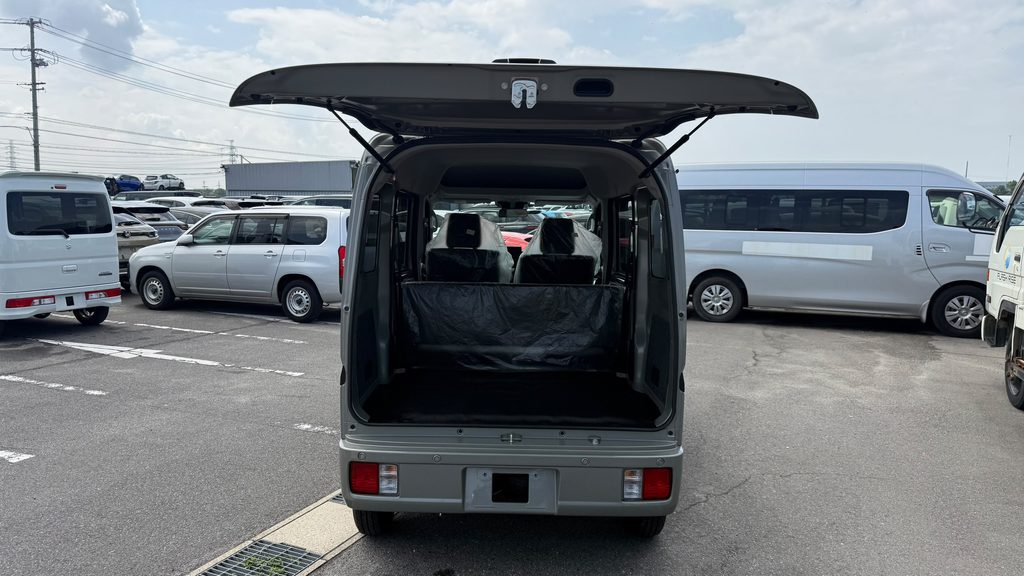
The current 2026 Suzuki Every DA18V available through UFS is listed in Japan with the following information:
| Vehicle detail | Current listing information |
|---|---|
| Chassis number | DA18V-106366 |
| Manufacture year | 2026 |
| Engine capacity | 660cc |
| Fuel | Petrol |
| Drive | 2WD |
| Transmission | Automatic |
| Mileage | 50 km |
| Exterior colour | Green |
| Length | 3.39 metres |
| Width | 1.47 metres |
| Height | 1.89 metres |
| Listed shipping volume | 9.52 m³ |
These figures describe the particular UFS stock unit and should not be assumed to represent every DA18V configuration. The final specification, seating, equipment and registration classification should be confirmed from the vehicle documents before purchase.
The listed UFS DA18V has a 660cc engine and only 50 kilometres of recorded mileage.
The listed vehicle measures approximately 3.39 metres long and 1.47 metres wide.
Safety technology varies by grade and package
The current Every range can include Suzuki Safety Support features such as:
- Dual Sensor Brake Support
- Lane-departure warning
- Lane-departure prevention assistance
- Vehicle-start notification
- Traffic-sign recognition
- Forward and reverse misapplication control
- Reverse brake support
- High-beam assistance
- Electronic Stability Program
- Hill-hold control
Adaptive cruise control and some additional features are connected to particular grades or upgrade packages. The all-around camera system is also an optional configuration rather than universal standard equipment.
Safety equipment must be verified by grade, not assumed from the model name.
Which 2026 Suzuki Every Grade Is Best for Sri Lanka?
The best 2026 Suzuki Every grade depends on whether you prioritise affordability, cargo work, passenger comfort or higher-performance equipment.
A buyer should select the grade according to the vehicle’s daily purpose rather than automatically choosing the cheapest or most expensive version.
| Grade | Likely buyer profile | Main priority |
|---|---|---|
| PA | Delivery and basic commercial users | Lower purchase cost and practical transport |
| PC | Mixed daily and light-business use | Better convenience with working-van practicality |
| JOIN | Personal and mixed passenger-cargo use | Improved comfort and cabin equipment |
| JOIN Turbo | Buyers wanting stronger performance and premium options | Higher equipment and easier loaded driving |
Choose PA for straightforward commercial use
The PA grade is generally the most work-focused choice. It suits buyers who need a compact van for deliveries, tools, products or service operations without paying for unnecessary comfort features.
However, a low purchase price should not be the only deciding factor. Check air-conditioning, windows, door locks, seating, safety equipment and transmission before approving the vehicle.
Choose PC for mixed personal and business driving
The PC grade can offer a better balance for buyers who expect to use the Every for both work and daily travel.
For example, a shop owner may use the van for inventory delivery during the week and personal transport during the weekend. Better convenience features can make that mixed use more comfortable.
Choose JOIN for greater passenger comfort
The JOIN grade is usually more suitable when passengers will regularly use the rear cabin.
A family buyer or professional service provider may value improved interior trim, rear-seat flexibility, keyless features and optional technology more than maximum cargo simplicity.
Choose JOIN Turbo for performance and equipment
The JOIN Turbo is aimed at buyers who want stronger acceleration and access to higher-specification equipment.
Suzuki lists an optional upgrade package for JOIN Turbo that can include powered rear sliding doors, automatic air-conditioning, a digital speedometer and adaptive cruise control.
The right grade is not universal. Share your use case, budget and required features when requesting a Suzuki Every personal-import quotation.
How Can You Personally Import a 2026 Suzuki Every to Sri Lanka?
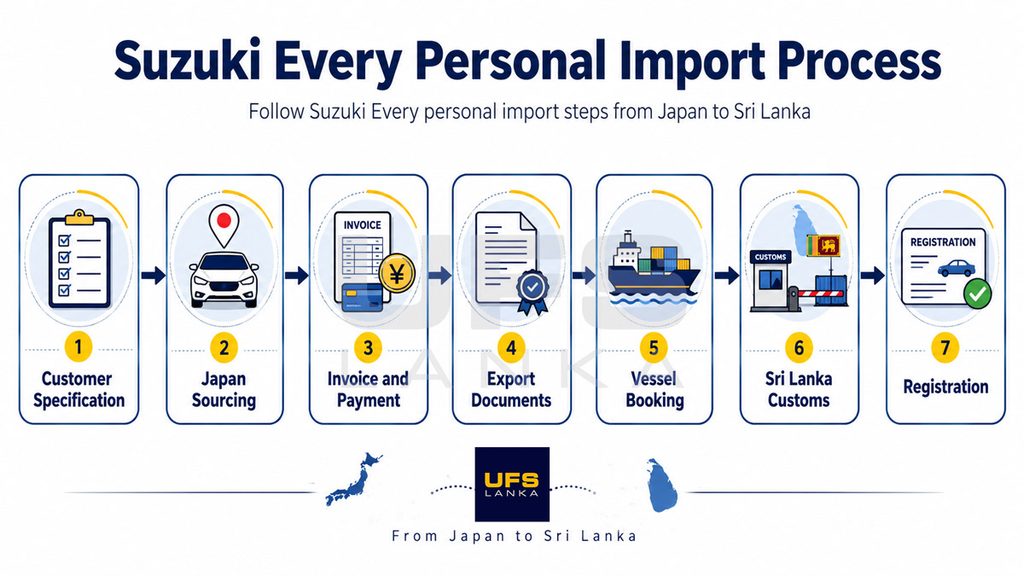
You can personally import a 2026 Suzuki Every by confirming eligibility, selecting the exact vehicle, approving a written quotation, completing payment, arranging export documentation and shipping, and preparing for Sri Lankan clearance and registration.
The process should follow a fixed sequence. Skipping an early verification step can create expensive problems after the vehicle has been purchased.
Step 1: Confirm current Sri Lankan import eligibility
Import eligibility is the first check because vehicle rules and tax treatment can change through Gazette notices, tariff updates and administrative instructions.
Before purchasing a DA18V, confirm:
- Whether the vehicle’s manufacture year is eligible
- Whether its body and use fall under the expected HS classification
- Whether it will be classified as a passenger vehicle or goods vehicle
- Whether a licence or special approval is required
- Whether a pre-export inspection is required
- Which banking and payment method is permitted
- Which documents must be issued in the customer’s name
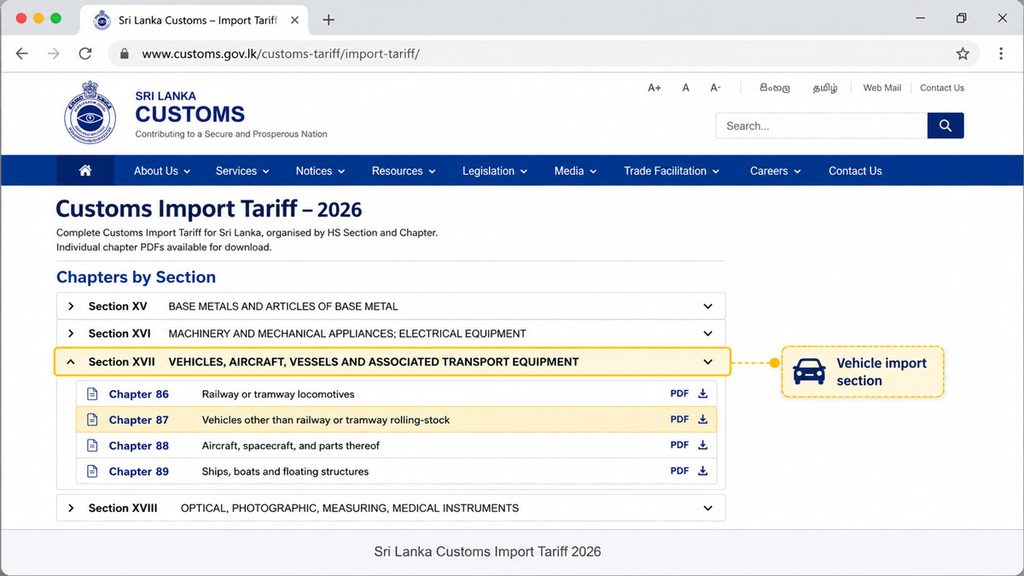
Sri Lanka Customs maintains a 2026 tariff guide that includes the section covering vehicles. The published tariff page was updated in May 2026, showing why buyers should use the current guide rather than screenshots of older calculations.
Step 2: Define the exact vehicle you want
A complete vehicle request reduces the risk of receiving a quotation for the wrong configuration.
Your request should state:
- Model: Suzuki Every
- Chassis series: DA18V
- Year: 2026
- Preferred grade
- Preferred colour
- 2WD or 4WD
- CVT or manual
- Turbo or non-turbo
- Required safety features
- Maximum total budget
- Intended personal or business use
For example, writing “I need a green Suzuki Every” is not enough. A stronger request would be: “I need a 2026 Suzuki Every DA18V PC or JOIN, 2WD CVT, with air-conditioning, rear passenger seating and safety support.”
Step 3: Select a vehicle from stock or Japanese supply channels
You can select a listed vehicle or ask the importer to source a suitable unit.
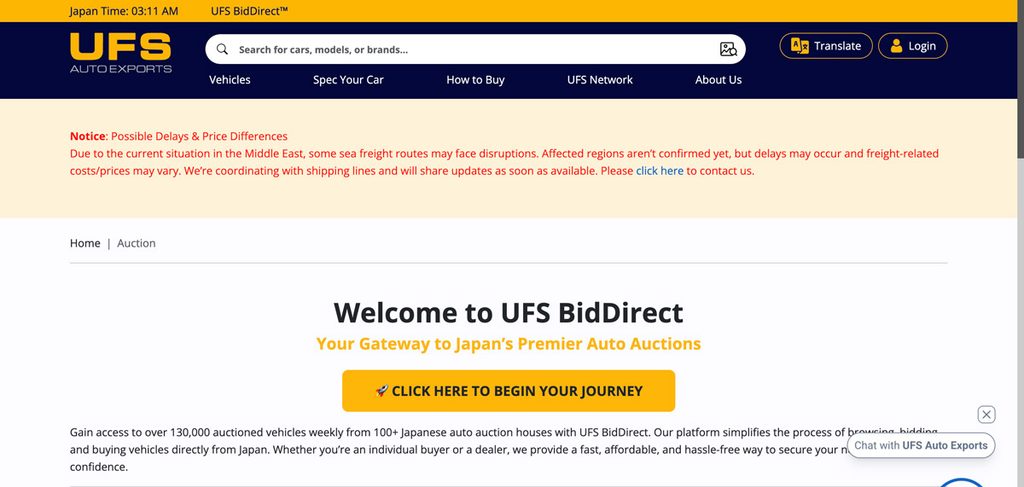
UFS currently offers a 2026 Suzuki Every DA18V in Japan. Buyers searching for another configuration can also explore the UFS Japanese vehicle auction platform.
UFS BidDirect states that its platform can provide access to more than 130,000 auction vehicles per week from over 100 Japanese auction houses.
For a brand-new or near-new DA18V, request:
- Clear exterior photographs
- Interior and cargo-area photographs
- Chassis plate photograph
- Odometer photograph
- Model and grade confirmation
- Equipment list
- Manufacture year and month
- Supplier or inspection report where applicable
Step 4: Review a written quotation
A reliable quotation should identify the vehicle and explain the payment structure.
The quotation should show:
- Vehicle price in Japan
- Exporter or service fee
- Inland transport in Japan
- Inspection cost
- Export-document charges
- Freight
- Marine insurance
- CIF value
- Estimated Sri Lankan taxes
- Estimated clearance and local costs
- Quotation validity period
- Exchange-rate conditions
A quotation that displays only one total figure is difficult to evaluate. Ask which expenses are included, excluded or estimated.
Step 5: Verify payment instructions
Payment verification is essential because vehicle-import scams frequently depend on rushed transfers and unrelated bank accounts.
Before transferring funds:
- Match the beneficiary name with the invoice
- Confirm the exporter’s official company details
- Verify bank instructions through an independent communication channel
- Check the chassis or stock number on the invoice
- Keep bank receipts and written correspondence
- Understand whether payment is refundable
- Confirm what happens if the vehicle becomes unavailable
Never send money to an employee’s or unknown third party’s personal account simply because the offer appears urgent.
Step 6: Complete Japan-side export preparation
Export preparation is the stage where the vehicle is collected, documented and prepared for shipment.
Depending on the transaction, the work may include:
- Supplier payment
- Vehicle collection
- Export deregistration
- Export certificate preparation
- Translation of Japanese documents
- Pre-export inspection
- Cleaning or biosecurity preparation
- Port transport
- Shipping booking
- Marine insurance
The exporter should confirm when each stage is completed. Buyers should also receive copies of important documents instead of relying only on verbal updates.
Step 7: Arrange shipping to Sri Lanka
Shipping moves the vehicle from the Japanese port to the agreed Sri Lankan destination port.
The two principal vehicle-shipping methods are:
RoRo shipping
RoRo means the vehicle is driven onto and off a specialised vessel.
This method is commonly used for operational vehicles because it avoids the space and loading requirements of a private container. Schedule availability and shipping-line requirements still affect the final timeline.
Container shipping
Container shipping places the vehicle inside a container, either alone or as part of a consolidated loading plan.
A container may offer additional physical separation during transit, but its cost depends on the loading arrangement, origin charges and number of vehicles sharing the container.
Your shipping confirmation should identify:
- Booking number
- Vessel name
- Port of loading
- Destination port
- Estimated departure date
- Estimated arrival date
- Freight terms
- Bill-of-lading instructions
Step 8: Prepare for clearance before arrival
Clearance preparation should begin before the vessel reaches Sri Lanka.
Sri Lanka Customs states that importers are legally responsible for correctly declaring imported goods and paying the correct duty before release. Customs also directs motor-vehicle importers to its Motor Vehicle Unit for the applicable procedure.
Your clearing agent may require advance copies of:
- Commercial invoice
- Bill of lading
- Export certificate
- English translation
- Inspection certificate
- Insurance certificate
- Customer identification
- Banking documents
- Import approvals where applicable
- Vehicle specification documents
Waiting until the vehicle arrives can increase the risk of storage, port and delay-related charges.
What Does a Suzuki Every CIF Price Include?
A Suzuki Every CIF price includes the cost of the vehicle, marine insurance and freight to the named Sri Lankan port.
CIF does not automatically mean that every expense up to road registration is included.
CIF versus landed cost
| Cost category | Normally part of CIF? | Normally part of final landed cost? |
|---|---|---|
| Japanese vehicle price | Yes | Yes |
| Freight to destination port | Yes | Yes |
| Marine insurance | Yes | Yes |
| Sri Lankan Customs duties | No | Yes |
| Import taxes and levies | No | Yes |
| Port charges | No | Yes |
| Clearing-agent fees | No | Yes |
| Registration costs | No | Yes |
| Local vehicle insurance | No | Yes |
| Inland delivery in Sri Lanka | Usually no | Yes, when requested |
| Storage or demurrage | No | Only when incurred |
The basic calculation is:
Vehicle cost + insurance + freight = CIF value
CIF value + Customs taxes + port charges + clearance + registration + local expenses = estimated total buyer cost
Why the final duty cannot be guessed from engine size alone
The final tax assessment can depend on more than the Every’s 660cc engine.
Relevant factors may include:
- HS code
- Passenger or goods classification
- Vehicle age
- Engine capacity
- Fuel type
- Customs value
- Applicable excise or other levies
- Official Customs exchange rate
- Current Gazette provisions
Sri Lanka Customs publishes current exchange rates separately, and the rate used for assessment may differ from the retail currency rate shown by a bank or online converter.
A CIF quotation is not the same as a guaranteed duty-paid price.
For a deeper explanation of the buying route, review the UFS guide on Japanese vehicle import costs and documents.
What Documents Are Needed to Import a Suzuki Every to Sri Lanka?
The essential Suzuki Every import documents normally include the commercial invoice, export certificate, bill of lading, insurance evidence and any inspection or approval documents required for the vehicle.
The final list depends on the transaction, Customs classification, payment method and prevailing import rules.
Documents required before payment
Before payment, the buyer should receive:
- Formal quotation
- Vehicle specification
- Stock or chassis reference
- Exporter’s company details
- Bank-payment instructions
- Terms and conditions
- Estimated CIF or landed-cost breakdown
- Import arrangement under the customer’s name
Documents issued after purchase
After the vehicle is purchased, the buyer should receive or be able to request:
- Commercial invoice
- Proof of purchase or payment acknowledgement
- Chassis number
- Vehicle photographs
- Odometer evidence
- Grade and configuration confirmation
- Manufacture details
Documents prepared before shipment
Before the vessel departs, the shipment file may contain:
- Export certificate
- Certified English translation where required
- Inspection certificate
- Marine insurance document
- Shipping booking confirmation
- Freight invoice
- Port or export paperwork
Documents issued after vessel loading
After the vehicle is loaded, the buyer should receive:
- Bill of lading or approved shipping document
- Vessel name
- Departure information
- Estimated arrival information
- Final account statement
- Clearance instructions
Details that must match
Check that the following details are consistent:
- Customer or importer name
- Chassis number
- Make and model
- Manufacture year
- Engine details
- Invoice value
- Destination port
- Shipping terms
A single incorrect chassis character can delay banking, clearance or registration. Compare the number character by character rather than checking it visually at a glance.
How Do Customs Clearance and Registration Work in Sri Lanka?
Customs clearance and registration are separate stages that move the Suzuki Every from port release to legal road use.
Customs determines the import declaration, classification, valuation and taxes. Registration is then completed through the relevant Sri Lankan motor-vehicle procedures after the vehicle is released.
Customs declaration and assessment
The clearing process generally involves:
- Obtaining the shipping-line delivery documents
- Preparing the Customs declaration
- Submitting the vehicle documents
- Confirming classification and value
- Completing any physical verification
- Paying duties, taxes and official charges
- Obtaining Customs release
- Removing the vehicle from the port or designated facility
The importer is responsible for making a correct declaration and paying the proper duty before receiving the vehicle.
Registration under the customer’s name
Registration connects the released vehicle to its legal Sri Lankan owner.
The documents and inspections required can depend on:
- Vehicle category
- Import arrangement
- Customs documents
- Customer identity
- Engine and chassis details
- Inspection requirements
- Current Department of Motor Traffic procedures
Sri Lanka’s Department of Motor Traffic provides an online service for checking registered vehicle information, including the make, model, manufacture year, engine number and vehicle class. This service becomes useful after registration when the owner wants to verify the recorded details.
Do not apply old rules to a new vehicle automatically
Some official guidance documents relate specifically to used vehicles imported under an import-control licence. Those documents may include scheme-specific restrictions that do not automatically apply to a brand-new 2026 DA18V.
For example, an Import and Export Control Department guide for certain used-vehicle licences refers to registration within two weeks and restrictions on transfer for five years. Buyers should not assume those conditions apply to every new-vehicle import without confirming the current scheme.
Always verify the rule that applies to your exact transaction before making payment.
What Mistakes Should You Avoid When Importing a Suzuki Every?
The most expensive Suzuki Every import mistakes come from choosing the wrong vehicle, misunderstanding the quotation or proceeding before eligibility and documentation are confirmed.
Mistake 1: Buying based only on the advertised year
The advertisement may state 2026, but buyers should check the manufacture information, chassis code and export documents.
Registration year, first-use year and manufacture year do not always mean the same thing.
Mistake 2: Confusing DA17V and DA18V
DA17V and DA18V identify different model series.
A seller should not replace the requested DA18V with an earlier DA17V simply because both vehicles look similar in photographs. Confirm the complete chassis number before approving payment.
Mistake 3: Assuming every grade has the same equipment
Suzuki lists several grades and optional packages.
Features such as powered sliding doors, adaptive cruise control, automatic air-conditioning and all-around cameras are not necessarily fitted to every vehicle.
Mistake 4: Comparing CIF with a duty-paid local price
CIF stops at cost, insurance and freight.
A local showroom price may already include duties, clearance, registration, financing expenses, stock costs and dealer margin. Compare equivalent cost stages.
Mistake 5: Accepting an undocumented “final tax”
Only the relevant authorities make the official assessment.
A dealer can provide an estimate based on current information, but exchange rates, valuation, tariff interpretation and regulatory changes may affect the final figure.
Mistake 6: Sending funds before confirming importer details
The name on the invoice, bank payment and import arrangement should be agreed before the transfer.
Correcting the importer or consignee after documents are issued may be complicated and expensive.
Mistake 7: Ignoring the vehicle’s intended use
The Every is practical, but the correct configuration depends on the buyer.
A cargo-focused grade may feel basic for family use. A higher-grade model may add cost without improving the needs of a delivery business.
Mistake 8: Waiting until arrival to arrange clearance
Late clearance preparation can create unnecessary port expenses.
Provide documents to the clearing agent early and ask whether any information is missing before the vessel arrives.
What Tools Can Help You Plan a Suzuki Every Personal Import?
The most useful personal-import tools are official tariff resources, verified vehicle listings, Japanese sourcing platforms, cost worksheets and registration-checking services.
These tools help the buyer move from a general enquiry to a verifiable purchase decision.
UFS Suzuki Every product page
Use the 2026 Suzuki Every DA18V product page to review the current stock number, chassis, year, mileage, engine, transmission, dimensions and photographs.
UFS Japan auction access
Use UFS BidDirect when the available stock vehicle does not match your preferred grade, colour or equipment.
The platform can support broader Japanese sourcing, but a buyer should still establish a maximum budget and confirm import eligibility before authorising a bid.
Sri Lanka Customs tariff guide
Use the official Sri Lanka Customs tariff resource to identify the current vehicle tariff section and confirm that your estimate is based on the latest publication.
Sri Lanka Customs exchange rates
Use the Customs exchange-rate page rather than assuming the duty calculation will use a public currency-converter rate.
Personal landed-cost worksheet
Create a worksheet with the following columns:
| Expense | Quoted amount | Currency | Confirmed or estimated | Responsible party |
|---|---|---|---|---|
| Vehicle | JPY | Confirmed | Buyer | |
| Japan charges | JPY | Confirmed | Buyer | |
| Freight | USD/JPY | Confirmed | Buyer | |
| Insurance | USD/JPY | Confirmed | Buyer | |
| Customs taxes | LKR | Estimated | Buyer | |
| Port and clearance | LKR | Estimated | Buyer | |
| Registration | LKR | Estimated | Buyer | |
| Local delivery | LKR | Optional | Buyer |
This worksheet prevents excluded charges from disappearing inside a verbal promise.
Frequently Asked Questions About Importing a Suzuki Every
The most common Suzuki Every import questions concern eligibility, final price, delivery time, ownership and grade selection.
Can I import a 2026 Suzuki Every under my own name?
Yes, a personal-import arrangement may be structured under the customer’s name when the vehicle and buyer meet current Sri Lankan import, banking, Customs and registration requirements.
The exact importer and consignee structure should be written into the quotation and confirmed before payment.
Is the Suzuki Every DA18V brand new?
A DA18V may be brand new or nearly new depending on the individual vehicle.
The current UFS stock example is listed as a 2026 vehicle with 50 kilometres, but buyers should verify the condition, manufacture details and documentation for the specific unit.
How much does a 2026 Suzuki Every cost in Sri Lanka?
The total cost depends on the grade, Japanese purchase price, options, freight, insurance, Customs valuation, taxes, exchange rate, clearance and registration.
A reliable seller should provide both a CIF breakdown and a clearly labelled estimated landed-cost calculation.
How long does shipping from Japan take?
The timeline depends on vehicle availability, payment, document preparation, inspection, vessel space, shipping schedule, port arrival and clearance.
A fixed delivery date should not be promised until the vehicle is purchased and the shipping booking is confirmed.
Is the Suzuki Every suitable for personal use?
Yes, the Suzuki Every can support personal use when the selected grade has appropriate seating, comfort and safety equipment.
JOIN or higher-equipped configurations may suit frequent passenger use better than a basic cargo-oriented PA.
Can the Suzuki Every be used for business?
Yes, the Every is well suited to deliveries, catering, florists, mobile services, online retail, technical work and other small-business activities.
The buyer should confirm vehicle classification, insurance and any regulations connected to the planned commercial use.
Is 2WD or 4WD better for Sri Lanka?
Two-wheel drive is generally sufficient for normal urban and paved-road use, while four-wheel drive may benefit buyers who frequently travel on steep, loose or difficult surfaces.
Four-wheel drive can increase purchase cost, weight and mechanical complexity, so it should be selected for a real need.
What Should You Do Next to Import a Suzuki Every?
Your next step is to prepare a clear vehicle request and obtain a written quotation based on your preferred DA18V specification.
Send the importer the following information:
- Your full name
- Contact number
- Preferred grade
- Preferred colour
- 2WD or 4WD
- CVT or manual
- Turbo or non-turbo
- Required features
- Intended use
- Maximum budget
- Preferred import timeline
Next, request:
- Vehicle availability
- Chassis and manufacture details
- Detailed photographs
- Feature confirmation
- CIF quotation
- Estimated Sri Lankan expenses
- Payment terms
- Importer and consignee arrangement
- Expected documentation
- Shipping process
Ready to Import Your 2026 Suzuki Every?
View the latest 2026 Suzuki Every DA18V available in Japan or explore vehicles selected for Sri Lankan buyers. Get transparent import support, CIF shipping and guidance throughout the process.
Request a 2026 Suzuki Every personal-import quotation
Choose your preferred grade, colour and specification, and ask UFS Lanka for a transparent quotation covering vehicle sourcing, Japan-side documentation, CIF shipping and Sri Lankan import guidance.
Recommended CTA buttons:
- View the 2026 Suzuki Every
- Request a CIF Quotation
- Import Under My Name
- Speak to UFS Lanka
Conclusion
A successful 2026 Suzuki Every personal import combines the correct vehicle, transparent pricing, accurate documents and early confirmation of Sri Lankan import requirements.
The DA18V can be a practical choice for daily travel, family requirements, deliveries and small-business work. However, the result depends on selecting the right grade and understanding the complete cost rather than focusing only on the Japanese price.
Confirm the chassis. Review the equipment. Separate CIF from the landed cost. Verify the importer details before payment. Prepare for clearance before arrival.
By following those steps and working with an experienced Japan-to-Sri Lanka import team, you can purchase your Suzuki Every with greater control, clearer documentation and fewer unexpected costs.