


First, you probably already know that Japanese cars are popular in Sri Lanka because they are reliable, fuel-efficient, and built to last. However, many buyers still feel unsure about the real import cost, latest rules, required documents, auction process, and safest way to buy from Japan. In this guide, we’ll explain how to import Japanese used cars to Sri Lanka step by step, including buyer scenarios, cost factors, best models, and how UFS Auto can help from vehicle sourcing to shipment.
Key Takeaways
- Japanese used car import to Sri Lanka involves sourcing, inspection, export documentation, shipping, customs clearance, and local registration.
- Sri Lankan buyers should calculate the full landed cost before choosing a vehicle, not only the Japan auction price or FOB price.
- Japan auction buying can offer strong value, but buyers need help reading auction sheets, checking grades, and confirming vehicle condition.
- Low-mileage Japanese cars, hybrids, and compact SUVs are popular choices because they balance comfort, fuel economy, resale value, and daily usability.
- A trusted import partner can reduce risk by helping with vehicle sourcing, documentation, shipping coordination, and cost guidance.
- Japan and Europe imports serve different buyer needs, so buyers should compare budget, vehicle type, maintenance, parts availability, and resale value before deciding.
What Is Japanese Used Car Import to Sri Lanka?
Japanese used car import to Sri Lanka is the process of sourcing a vehicle from Japan, arranging export documents, shipping it to Sri Lanka, clearing it through customs, and registering it for local road use.
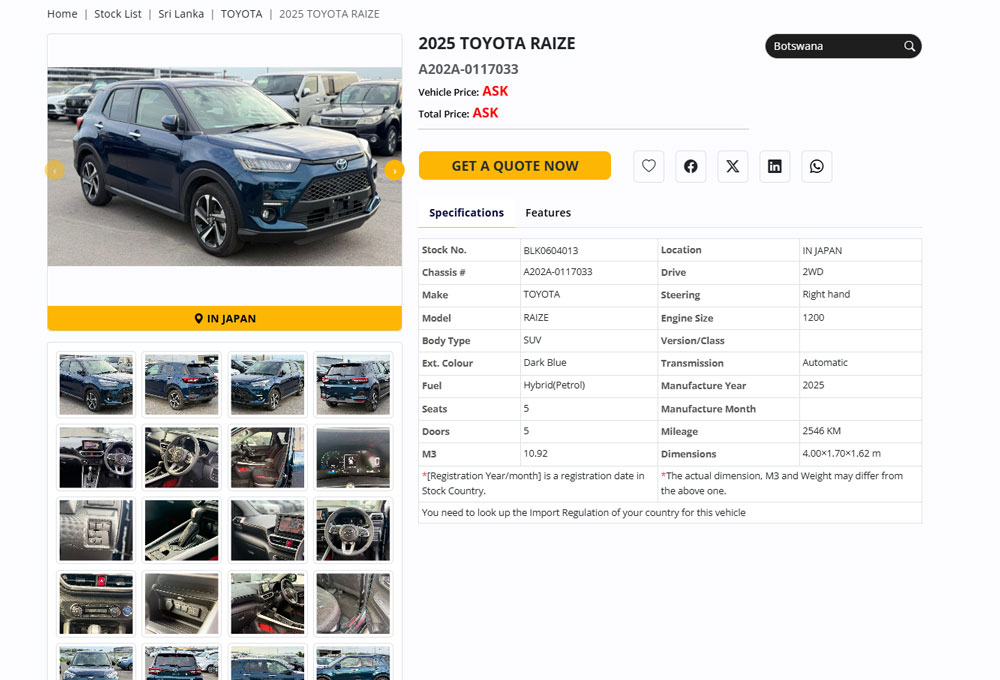
First, the buyer chooses a vehicle from a Japan auction, dealer stock, or exporter inventory. For example, a Sri Lankan buyer may choose a Toyota Raize Hybrid, Honda Vezel, Suzuki Wagon R, or Nissan Dayz based on budget, engine size, mileage, and intended use.
Moreover, the import process is not only about buying a car overseas. It also includes checking the vehicle’s age, confirming Sri Lanka import eligibility, arranging inspection, preparing documents, booking shipment, calculating duties, and clearing the vehicle at Colombo port.
In addition, UFS Auto supports buyers who want a guided process instead of guessing each step alone. You can explore available vehicles through available Japanese cars for Sri Lanka and compare options before making a decision.
Why Is Importing Japanese Used Cars to Sri Lanka Important?
Importing Japanese used cars to Sri Lanka is important because it gives buyers access to a wider selection of vehicles, better mileage options, transparent auction data, and models that may not be easily available in local stock.
First, Japan has a strong used-car ecosystem with detailed auction sheets, mileage records, inspection grades, and vehicle condition reports. For example, a buyer looking for a low-mileage 2025 Nissan Dayz may find more choices in Japan than in the local Sri Lankan market.
Second, the Sri Lankan import market has become active again after a long period of restrictions. The Central Bank of Sri Lanka reported that vehicle imports reached US$195 million in March 2026 and US$613 million during the first quarter of 2026 – Source: (Central Bank of Sri Lanka)
Moreover, this renewed demand means buyers need faster and clearer guidance. By working with an experienced company such as UFS Auto, you can compare Japan stock, check direct import cars from Japan to Sri Lanka, and request support before committing funds.
How Does the Car Import Process from Japan to Sri Lanka Work?
The car import process from Japan to Sri Lanka works by selecting a suitable vehicle, confirming import eligibility, completing payment and documentation, shipping the vehicle, and clearing it through Sri Lankan customs.
First, buyers should avoid starting with only the cheapest auction price. Instead, the better method is to start with your final landed budget in Sri Lanka, because taxes, freight, inspection, and clearing charges can significantly change the total cost.
Step 1: Choose Your Budget, Vehicle Type, and Purpose
First, your budget should decide the vehicle category before the model. For example, a buyer with a family may choose a compact SUV such as a Toyota Raize, while a city buyer may prefer a Suzuki Wagon R or Nissan Dayz for fuel economy and easy parking.
Moreover, your purpose affects the best import choice. A daily-use buyer may focus on fuel economy, while a business owner may prioritize resale value, durability, and availability of spare parts.
Step 2: Source the Vehicle from Japan
Second, vehicle sourcing means finding a suitable unit through auction, dealer stock, exporter stock, or UFS Auto’s available inventory. For example, Japan auction cars may offer more choice, while ready stock can reduce the time needed to confirm a unit.
In addition, buyers who want auction support can use the Japan car auction buying guide to understand bidding, auction grades, and how UFS BidDirect works.
Step 3: Verify the Auction Sheet or Stock Details
Third, vehicle verification protects the buyer from hidden problems. For example, an auction sheet can reveal accident history, paint marks, scratches, dents, interior condition, and mileage notes.
Moreover, Japanese auction grades should not be read blindly. A Grade 4 car may still have visible marks, while a lower-grade vehicle may still be acceptable if the issues are minor and clearly explained.
Step 4: Confirm the Full Landed Estimate
Fourth, the full landed estimate should include the vehicle price, FOB, freight, insurance, inspection, documentation, duties, clearing charges, and registration-related expenses. The total cost to import a car from Japan to Sri Lanka includes the vehicle price, freight, insurance, inspection, export documentation, customs duties, clearing charges, and registration-related costs.
For example, a car that looks affordable in Japan may become expensive in Sri Lanka if the engine size, CIF value, luxury tax category, or duty structure increases the final cost.
Step 5: Arrange Payment, Documents, and Shipping
Fifth, the exporter arranges Japan-side documents and shipment once the vehicle is purchased and payment requirements are completed. For example, required documents may include the invoice, export certificate, inspection certificate, bill of lading, and insurance documents.
At the same time, buyers should confirm whether the vehicle requires JAAI or another accepted inspection before export. Several import-regulation sources identify JAAI inspection as a key pre-shipment requirement for Sri Lanka-bound vehicles.
Step 6: Clear the Vehicle at Colombo Port
Finally, Colombo port clearance involves submitting import documents, customs declarations, valuation details, and tax payments through the proper channels. Sri Lanka Customs publishes the National Imports Tariff Guide 2026 as a reference for importers, declarations, and revenue collection – Source: (Sri Lanka Customs)
Moreover, the ASYCUDA system calculates duties and taxes based on HS codes and required data submitted through CusDec – Source: (Sri Lanka Customs)
How Much Does It Cost to Import a Car from Japan to Sri Lanka?
The cost to import a car from Japan to Sri Lanka depends on the vehicle price, CIF value, engine type, engine capacity, freight, insurance, inspection, taxes, clearing charges, and registration-related expenses.
First, buyers should understand that FOB price is not the final Sri Lanka price. For example, if a vehicle costs less in Japan but attracts higher duties due to engine size or category, the final landed cost may still be higher than expected.
Main Cost Components for Sri Lankan Buyers
First, the cost structure usually includes several layers. The table below gives a simple buyer-friendly overview.
| Cost Component | What It Means | Why It Matters |
| Vehicle price | Auction or dealer price in Japan | Starting point of the import cost |
| FOB cost | Vehicle price plus Japan-side export costs | Helps calculate export value |
| Freight | Shipping cost to Sri Lanka | Changes by vessel, port, and vehicle size |
| Insurance | Marine insurance during shipment | Protects the vehicle during transit |
| Inspection | Pre-shipment inspection such as JAAI where applicable | Required for compliance |
| Customs duty/taxes | Sri Lanka government import taxes | Usually the biggest cost factor |
| Clearing charges | Local clearance, port, and agent-related costs | Needed to release the vehicle |
| Registration costs | Local registration and road-use preparation | Required before road use |
Moreover, Sri Lanka Customs’ 2026 tariff resources include vehicle-related classifications under Chapter 87 for motor vehicles – Source: (Sri Lanka Customs)
Why CIF Value Matters for Import Cost
CIF value is the cost, insurance, and freight value used as a base for customs valuation and tax calculation.
For example, if two vehicles have similar auction prices but different freight or insurance values, their CIF values may differ. That difference can affect duty calculation and final landed cost.
In addition, buyers should request a proper estimate before purchase. UFS Auto can help you compare the likely landed cost before choosing a vehicle from available Japanese cars for Sri Lanka.
What Documents Are Needed to Import a Japanese Car to Sri Lanka?
The documents needed to import a Japanese car to Sri Lanka usually include the commercial invoice, bill of lading, export certificate, inspection certificate, insurance certificate, and customs declaration documents.
First, documentation is one of the most important parts of the import journey. For example, missing or incorrect vehicle details can delay customs clearance and increase storage or handling costs.
Common Import Documents
First, buyers should prepare for these common documents:
- Commercial invoice
- Bill of lading
- Export certificate
- Inspection certificate
- Insurance certificate
- Vehicle registration/export records
- Customs declaration documents
- Buyer identification and bank/payment-related documents where required
Moreover, some regulation sources list documents such as the original bill of lading, commercial invoice, JAAI pre-shipment inspection certificate, letter of credit or payment-related documents, export certificate, insurance certificate, and customs declaration.
Why Document Accuracy Is Critical
Document accuracy is critical because customs clearance depends on matching vehicle details, shipment records, valuation information, and import eligibility.
For example, if the chassis number, model year, engine details, or invoice value does not match supporting documents, the clearance process can become slower and more complicated.
In addition, buyers can reduce risk by working with an import partner that checks the process from Japan-side documentation to shipment coordination.
What Are the Current Sri Lanka Import Rules for Japanese Used Cars?
Sri Lanka import rules for Japanese used cars include vehicle age limits, right-hand-drive requirements, inspection requirements, customs valuation, import duties, and documentation controls.
First, buyers must check rules before choosing a vehicle. For example, a vehicle that looks attractive in Japan may not be eligible if it exceeds the permitted age category or fails required inspection standards.
Vehicle Age and Eligibility
Vehicle age limits are one of the first checks Sri Lankan buyers should make before importing. Some current import-regulation sources state that passenger cars and SUVs generally fall under a 3-year age limit, while other vehicle categories may have different limits – Source: (JapaneseCarTrade.com)
However, import rules can change quickly. Therefore, buyers should verify eligibility with the latest Sri Lanka Customs, Import Control, bank, or clearing-agent guidance before confirming a purchase.
Right-Hand Drive and Inspection Requirements
Right-hand-drive eligibility matters because Sri Lanka drives on the left side of the road. For example, Japanese domestic market vehicles are usually right-hand drive, which makes them more suitable for Sri Lankan buyers than many left-hand-drive markets.
Moreover, pre-shipment inspection can be required before the vehicle leaves Japan. This is why buyers should confirm inspection requirements before bidding at auction or buying from stock.
What Are the Best Japanese Cars to Import to Sri Lanka?
The best Japanese cars to import to Sri Lanka are usually fuel-efficient, easy to maintain, strong in resale value, and suitable for local road conditions.
First, Sri Lankan buyers often prefer Japanese compact SUVs, hybrids, hatchbacks, and Kei cars because they balance price, comfort, and running cost. For example, a compact hybrid SUV may suit a family, while a Kei car may suit city driving.
Popular Japanese Models for Sri Lanka
First, these models are strong options for many Sri Lankan buyers:
- Toyota Raize – compact SUV with strong city usability
- Honda Vezel – stylish hybrid SUV with good comfort
- Suzuki Wagon R – fuel-efficient city car with practical space
- Toyota Yaris – reliable hatchback for daily use
- Toyota Aqua – popular hybrid with strong fuel economy
- Nissan Dayz – Kei car option for urban buyers
Popular Indian Models for Sri Lanka
- Toyota Taisor – newer compact SUV option
- Toyota Urban Cruiser Hyryder – hybrid SUV choice for families
Moreover, model-specific content converts better than broad import guides. A buyer searching for Toyota Raize import price in Sri Lanka is usually closer to purchase than someone searching only “Japanese cars.”
Best Cars by Buyer Scenario
First, different buyers need different vehicles. The table below shows practical matching.
| Buyer Scenario | Recommended Vehicle Type | Example Models |
| First-time importer | Reliable compact car | Suzuki Wagon R, Toyota Yaris |
| Family buyer | Compact SUV or hybrid SUV | Toyota Raize, Honda Vezel |
| City driver | Kei car or small hatchback | Nissan Dayz, Suzuki Wagon R |
| Fuel-saving buyer | Hybrid vehicle | Toyota Aqua, Honda Vezel |
| Premium buyer (Indian) | Newer low-mileage unit | Toyota Taisor, Toyota Hyryder |
| Budget-focused buyer | Smaller engine vehicle | Wagon R, Dayz, Yaris |
In addition, buyers can compare low mileage Japanese cars for Sri Lanka to find options with better condition and stronger long-term value.
Is It Better to Buy from Japan Auction or Ready Stock?
Japan auction is better for buyers who want wider choice and price flexibility, while ready stock is better for buyers who want faster confirmation and less waiting time.
First, Japan auctions give access to thousands of vehicles across many auction houses. For example, a buyer looking for a specific grade, color, mileage, and budget may have a better chance through auctions.
When Japan Auction Makes Sense
Japan auction makes sense when you want more choice, transparent condition reports, and the chance to bid within your budget.
For example, a buyer searching for a Toyota Raize Hybrid Z grade may wait for the right unit to appear at auction instead of accepting whatever is available locally.
Moreover, UFS Auto’s auction access helps buyers understand the process before bidding. You can review the Japan car auction buying guide before deciding whether auction buying suits your budget and timeline.
When Ready Stock Makes Sense
Ready stock makes sense when you want faster purchase confirmation and less uncertainty.
For example, if UFS Auto already has a suitable vehicle available, the buyer can review the unit details, confirm the price, and move forward faster than waiting for auction availability.
In addition, ready stock can be useful when market demand is high and buyers want to secure a vehicle before price changes or stock shortages.
What Is the Difference Between Japan and Europe Car Import to Sri Lanka?
Japan and Europe car imports differ in vehicle type, pricing, specifications, parts availability, brand preference, and long-term maintenance expectations.
First, Japan is often stronger for fuel-efficient hybrids, compact SUVs, Kei cars, and practical family vehicles. For example, Toyota, Honda, Suzuki, Nissan, and Mazda models are widely known in Sri Lanka and often have better local familiarity.
Second, Europe may appeal to buyers who want premium brands, specific luxury features, or European driving feel. For example, a buyer considering Volkswagen, Audi, BMW, or Mercedes-Benz may compare European availability with Japanese-market options.
Japan vs Europe Import Comparison
| Factor | Japan Import | Europe Import |
| Best for | Hybrids, compact SUVs, Kei cars, fuel-efficient models | Premium brands, luxury features, European specifications |
| Common brands | Toyota, Honda, Suzuki, Nissan, Mazda | Volkswagen, Audi, BMW, Mercedes-Benz |
| Sri Lanka familiarity | Very strong | Strong for selected premium segments |
| Parts availability | Usually easier for popular Japanese models | Depends on brand and model |
| Buyer type | Family buyers, daily drivers, budget-conscious buyers | Premium buyers and brand-focused buyers |
Moreover, UFS Auto can support buyers who want Japan vs Europe car import to Sri Lanka guidance before selecting a vehicle.
How Long Does It Take to Import a Car from Japan to Sri Lanka?
The time to import a car from Japan to Sri Lanka depends on vehicle sourcing, payment completion, inspection, document readiness, vessel schedule, shipping time, and customs clearance.
First, auction buying can take longer if the buyer is waiting for a specific model, grade, color, and price. For example, a buyer looking for a very low-mileage Honda Vezel in a specific color may need more time than a buyer who is flexible.
Moreover, shipment timing depends on vessel availability and port scheduling. After arrival in Sri Lanka, clearance timing depends on document accuracy, customs process, duty payment, and local handling.
In addition, buyers should not plan only around shipping days. The full import timeline includes sourcing, purchase, inspection, documentation, shipment, port arrival, clearance, and registration preparation.
What Practical Tools and Examples Help Sri Lankan Buyers Import Cars?
Practical tools help Sri Lankan buyers import cars by turning a complicated process into clear steps, cost estimates, model comparisons, and document checklists.
First, buyers should use a vehicle import checklist before confirming any purchase. For example, the checklist should include budget, model, year, mileage, engine size, inspection requirement, auction sheet, CIF estimate, and document status.
Useful Tools for Buyers
First, these tools can help buyers make better decisions:
- UFS Auto stock search for available Japan and Sri Lanka units
- Japan auction sheet review for condition checking
- Cost estimate sheet for comparing FOB, freight, and duties
- Document checklist for avoiding clearance delays
- Model comparison table for budget and use-case planning
- WhatsApp consultation for quick buyer guidance
Moreover, buyers can compare brand-new Japanese cars for Sri Lanka if they prefer newer units with very low mileage.
![Explain car import process from Japan to Sri Lanka”]](https://ufsauto.jp/blogs/wp-content/uploads/2026/05/car-import-process-from-Japan-to-Sri-Lanka.jpg)
Example Buyer Scenario: Toyota Raize Import
Toyota Raize import from Japan to Sri Lanka is a strong option for buyers who want a compact SUV with city-friendly size, good fuel economy, and Toyota resale value.
For example, a buyer can compare petrol and hybrid grades, check mileage, review auction sheet condition, and request a landed-cost estimate before purchase. This helps avoid choosing a vehicle only because the auction price looks attractive.
Example Buyer Scenario: Honda Vezel Import
Honda Vezel import from Japan to Sri Lanka is a strong option for buyers who want a stylish hybrid SUV with comfort, technology, and good daily usability.
For example, a buyer can compare year, grade, hybrid system, mileage, and total import cost before deciding whether Vezel gives better value than Toyota Raize or another SUV.
How Can UFS Auto Help with Direct Car Import to Sri Lanka?
UFS Auto helps Sri Lankan buyers source vehicles from Japan, review available units, understand import costs, and coordinate the vehicle import journey from selection to shipment.
First, UFS Auto gives buyers access to Japanese vehicle options, auction support, direct sourcing guidance, and available stock. For example, a buyer can send a preferred model, budget, year, and mileage requirement to get suitable options.
Moreover, UFS Lanka supports buyers who want local communication and guidance during the process. This is especially useful for first-time importers who need help understanding documentation, landed cost, and timeline.
In addition, UFS Auto’s wider network supports buyers across markets. You can explore the UFS Auto global network to understand how the company connects Japan-side sourcing with destination-market support.
Real Customer Experience with UFS Auto
See how UFS Auto helps customers source, import, and receive quality vehicles with confidence. This real customer experience shows the trust, service, and support behind every vehicle journey.
What Should You Do Next Before Importing a Car from Japan to Sri Lanka?
The next step before importing a car from Japan to Sri Lanka is to confirm your budget, shortlist suitable models, check import eligibility, and request a full landed-cost estimate before buying.
First, start with your Sri Lanka budget rather than only the Japan price. For example, if your final budget is around Rs. 12M–15M, your vehicle shortlist should be built around total landed cost, not only auction price.
Second, compare at least three models before deciding. For example, a compact SUV buyer may compare Toyota Raize, Honda Vezel, and Toyota Taisor based on price, fuel economy, resale value, and maintenance.
Third, contact UFS Auto with your preferred model, budget, year, mileage, and delivery expectation. By doing this early, you can avoid vehicles that are not suitable for Sri Lanka import rules or your final budget.
Conclusion
Importing Japanese used cars to Sri Lanka becomes easier when you understand the process, calculate the full landed cost, check the latest rules, and choose the right import partner.
Moreover, Japanese cars remain popular because they offer reliability, fuel economy, strong resale value, and a wide range of options for different buyers. Whether you want a Toyota Raize, Honda Vezel, Suzuki Wagon R, Nissan Dayz, or another Japanese vehicle, the smartest move is to compare the full cost before purchase.
Finally, UFS Auto can help you source the right vehicle, check available units, understand the import journey, and move forward with more confidence. Send your preferred model, budget, and expected timeline to UFS Auto to begin your direct import plan.
Written by UFS Auto Editorial Team – Vehicle import content team focused on Japanese vehicle sourcing, Sri Lanka buyer guidance, and international auto export education.
Reviewed by UFS Lanka Vehicle Import Team – Sri Lanka market team with practical experience in buyer support, vehicle selection, import coordination, and destination-market guidance.