
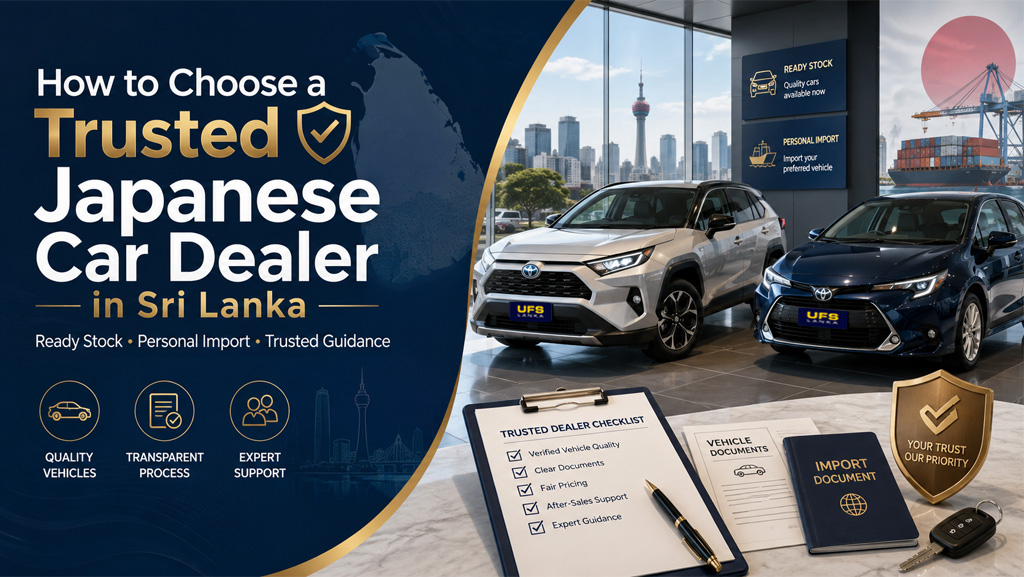
Buying a Japanese car in Sri Lanka is no longer just about finding the lowest advertised price. For many buyers, the bigger question is far more important: Can this dealer be trusted with my money, my documents, and my vehicle selection?
Today, Sri Lankan car buyers usually have two main options. They can choose ready stock that is already available locally, or they can go for personal import from Japan, where the vehicle is sourced and imported direct to the buyer’s name. Both options can be smart. Both can also become expensive if the buyer works with the wrong dealer.
A trusted Japanese car dealer is not simply someone who posts attractive vehicle photos online. A trusted dealer should be able to prove the vehicle source, explain the import process, show inspection and vehicle documents, provide a transparent cost breakdown, guide the payment process, and support the buyer after the car arrives.
This matters even more because Sri Lanka’s vehicle import environment changed after years of restrictions. With imports reopened under specific rules, buyers must pay close attention to compliance, registration timing, inspection requirements, and proper documentation. A small mistake can lead to delays, extra costs, or disappointment.
This guide explains how to choose a trusted Japanese car dealer in Sri Lanka, whether you want a car from ready stock or a personal import from Japan direct to your name.
1. Start With the Dealer’s Real Business Model
Before comparing prices, first understand what type of dealer you are dealing with.
In Sri Lanka, most Japanese car sellers fall into one of three categories:
- Ready-stock showroom dealers
These dealers offer vehicles that are already available locally. The buyer can usually inspect the car, check the condition, review documents, and make a faster purchase decision. - Japan auction or import agents
These agents help buyers source vehicles from Japan through auctions, dealer stock, or supplier networks. The car may not be in Sri Lanka yet, so the buyer depends heavily on the agent’s sourcing, documentation, inspection, and shipping process. - Hybrid dealers offering both showroom stock and personal import
These dealers provide both options: vehicles already available for viewing and personal import support for buyers who want a specific model, grade, colour, mileage, or budget range.
A serious dealer should clearly explain whether the vehicle is:
- Already in Sri Lanka
- In transit
- Available in Japan stock
- Available through auction
- Yet to be sourced
- Reserved for another buyer
- Owned by the dealer or advertised on behalf of another supplier
This is a simple question, but it reveals a lot.
Ask the dealer directly:
“Is this vehicle already available, or does it still need to be sourced from Japan?”
Also ask:
“Is this vehicle owned by your company, reserved for another client, or only advertised from Japan stock?”
A trusted dealer will answer clearly. An unreliable seller may give vague responses such as “available soon,” “can arrange,” or “just pay advance first” without explaining the actual vehicle status.
For Sri Lanka buyers, a hybrid dealer can be especially useful. It allows you to compare a car you can inspect today against a vehicle that can be imported from Japan to match your exact requirement. This gives more control and reduces impulsive buying.
The goal is not only to find a car. The goal is to know exactly what you are buying, where it is located, and what process is required before it reaches your name.
2. Check Whether the Dealer Can Support Personal Import Direct to Your Name
Personal import is different from simply buying a car from a showroom.
Under personal import, the vehicle is imported for the buyer’s personal use and registered under the buyer’s name according to Sri Lanka’s applicable rules. This route is attractive for buyers who want more control over the model, grade, mileage, colour, condition, and price range.
However, personal import is a regulated process. It involves more than selecting a car from a website.
A trusted dealer should explain the full journey before asking for payment. That includes:
- Vehicle selection
- Quotation and cost breakdown
- Banking, LC, or approved payment route
- Japan-side invoice and export documents
- Inspection coordination
- Shipping arrangement
- Bill of Lading
- Arrival updates
- Customs clearance support
- Registration guidance with the Department of Motor Traffic
The dealer should also be able to give you a realistic timeline. Not a vague promise. A practical timeline.
Ask:
“Can you explain each step from vehicle confirmation to registration in Sri Lanka?”
A professional dealer should be able to explain what happens after the vehicle is selected, what documents are needed, when inspection happens, when shipping is arranged, and what the buyer must prepare on the Sri Lanka side.
This is where trust becomes visible.
A dealer who only says “we can import” may not be enough. A dealer who can explain the Japan-side and Sri Lanka-side process in detail is far more valuable.
Personal import direct to your name requires coordination. The dealer must understand Japan sourcing, export documentation, inspection requirements, shipping, Customs, and registration. If one part is mishandled, the buyer may face delays or extra costs.
For serious buyers, the best dealer is not necessarily the one who gives the lowest first quote. It is the one who can guide the transaction correctly from the first discussion to final handover.
3. Demand a Transparent Price Breakdown Before Paying
Price transparency is one of the clearest signs of a trusted Japanese car dealer in Sri Lanka.
Many buyers make the mistake of comparing only the advertised vehicle price. But the real cost of an imported vehicle includes several components. A low headline price can become expensive when key charges are added later.
A trusted dealer should separate the quotation clearly.
The quote should explain items such as:
| Cost Item | What It Means |
| Vehicle Price | The base price of the vehicle in Japan or local stock |
| Auction or Stock Cost | Cost depending on auction purchase or fixed dealer stock |
| Japan-Side Charges | Export handling, documentation, yard, or inland charges |
| Inspection | JAAI, JEVIC, or approved inspection-related cost if applicable |
| Inland Transport | Movement from auction or seller location to yard/port |
| Shipping | Freight from Japan to Sri Lanka |
| Insurance | Marine insurance if included |
| CIF Value | Cost, Insurance, and Freight value used for import calculations |
| Customs Duty and Taxes | Sri Lanka Customs-related duties and taxes |
| Clearing Charges | Port, agent, and clearance-related charges |
| Registration | DMT registration-related expenses |
| Delivery | Transport to showroom or buyer location, if applicable |
A buyer should also understand the difference between FOB, CIF, landed cost, and duty-paid price.
FOB usually refers to the vehicle price up to the export point, excluding shipping and destination-side costs.
CIF means Cost, Insurance, and Freight. This includes the vehicle cost, insurance, and shipping up to the destination port.
Landed cost usually refers to the total cost after the vehicle arrives and clears major import-related charges.
Duty-paid price generally means the price after applicable local duty and taxes are included.
These terms matter because two dealers may quote the same vehicle in completely different ways. One may quote only FOB. Another may quote CIF. Another may quote a duty-paid figure. Unless the buyer knows what is included, the comparison is misleading.
Before paying an advance, ask:
“Is this price FOB, CIF, landed, or duty-paid?”
Then ask:
“What exactly is included and what is not included?”
A trustworthy dealer will not be offended by this question. In fact, a professional dealer should welcome it because transparent pricing protects both the buyer and the seller.
Avoid any quotation that says only “best price” without explaining the full structure. The cheapest-looking offer can hide the most uncertainty.
4. Verify Inspection, Auction Sheet, and Vehicle Condition
Japanese vehicles are popular in Sri Lanka because they are known for reliability, build quality, technology, and strong resale value. But every vehicle must still be verified properly.
Photos alone are not enough.
A trusted Japanese car dealer should be able to provide or explain important condition documents, especially when the vehicle is sourced from Japan.
For used vehicles, buyers should ask for:
- Auction sheet, if purchased through auction
- Chassis number
- Mileage details
- Auction grade or vehicle grade
- Interior and exterior condition notes
- Repair or accident notes, if any
- Vehicle photos from different angles
- Export certificate
- Pre-shipment inspection status
- JAAI, JEVIC, or approved inspection support where applicable
An auction grade is useful, but it should not be treated as the only proof of condition. A high grade may indicate a cleaner vehicle, but buyers should still check the chassis number, mileage, interior condition, exterior marks, repair notes, and inspection requirements.
The auction sheet should also be explained in simple language. Many buyers see codes and marks but do not fully understand what they mean. A professional dealer should explain dents, scratches, replaced panels, repair marks, mileage notes, and interior grade.
Be cautious if a seller says:
- “Grade 5, no need to check”
- “Auction sheet not available”
- “Chassis number later”
- “Mileage is guaranteed but no document now”
- “Inspection can be done after payment only”
- “Trust me, this is a very clean car”
Trust should not depend only on words. It should be supported by documents.
For Sri Lanka imports, inspection is especially important because used vehicles under relevant motor vehicle HS codes are subject to pre-shipment inspection requirements. This means the dealer must understand inspection timing before the vehicle is shipped, not after it reaches Sri Lanka.
A beautiful car with incomplete documents can become a complicated purchase. A verified car with proper documents is much safer.
5. Compare Ready Stock vs Personal Import Honestly
Many buyers ask one question first:
“Which is cheaper?”
A better question is:
“Which option is right for my budget, timeline, and risk level?”
Ready stock and personal import both have advantages. The correct choice depends on the buyer.
Choose ready stock if:
| Ready Stock Is Better When… | Why It Helps |
| You want to inspect the car physically | You can see the condition before purchase |
| You need faster delivery | The car is already local or closer to handover |
| You want less waiting time | No need to wait for sourcing and shipping |
| You prefer a simpler buying process | Documents and costs may already be clearer |
| You want immediate comparison | You can compare available vehicles in the showroom |
Ready stock is not automatically overpriced. A vehicle already in Sri Lanka may include duty, local handling, showroom support, inspection, documentation, and the convenience of immediate availability.
That convenience has value.
Choose personal import if:
| Personal Import Is Better When… | Why It Helps |
| You want a specific model or grade | Japan offers wider sourcing options |
| You want a certain colour or mileage | You are not limited to local stock |
| You want the car direct to your name | It supports buyer-name import structure |
| You are willing to wait | More time allows better sourcing |
| You want more control over selection | You can choose based on budget and condition |
Personal import can be powerful, but it is not always cheaper in every case. Exchange rates, shipping cost, inspection requirements, Japan market prices, and timing can change the final cost.
This is why a trustworthy dealer should not push one route blindly.
Instead, the dealer should help you compare both options. For example:
- What can you buy from ready stock today?
- What can be imported from Japan within your budget?
- What is the expected timeline?
- What is the likely final cost?
- Which option gives better value after considering risk, time, and condition?
The best dealer is not the one who forces a decision. The best dealer helps you make a confident decision.
6. Check Local Presence, Showroom Trust, and After-Sales Support
A trusted Japanese car dealer in Sri Lanka should be reachable beyond social media messages.
Social media is useful for discovering vehicles, but it should not be the only proof of business credibility. Before making a serious payment, buyers should look for local presence and accountability.
Check whether the dealer has:
- A verifiable showroom or office
- A clear business name
- Contact numbers that work consistently
- WhatsApp support
- Staff who can explain the process clearly
- Vehicle viewing options
- Document review before final payment
- Customer delivery history
- Google Business Profile or map visibility
- Clear follow-up support
If the vehicle is already in ready stock, the dealer should allow the buyer to inspect it, verify the chassis number, check the condition, and review available documents.
After-sales support is also important.
Ask whether the dealer assists with:
- Customs clearance updates
- Registration guidance
- Inspection certificate handover
- Spare key and document handover
- Service or maintenance referrals
- Future sourcing or trade-in guidance
A car purchase does not end when the buyer pays. It ends when the buyer receives the vehicle with the correct documents and proper confidence.
Google reviews can help, but reviews should not replace document verification. A dealer may have good reviews and still fail to explain a specific vehicle clearly. Likewise, a new showroom may be genuine but still needs to prove its process.
Use reviews as one signal. Use documents as the stronger signal.
7. Ask About Payment Safety Before Sending an Advance
Payment safety is one of the biggest concerns for Sri Lankan buyers, especially when importing a car direct to their name.
Before sending any advance, the dealer should explain:
- Who receives the payment
- Whether the payment goes to a company account
- What invoice or receipt is issued
- What vehicle details are written on the invoice
- What happens if the vehicle cannot be secured
- Whether the advance is refundable or adjustable
- What documents are provided after payment
- What the next milestone is
Avoid cash-only arrangements or payments to unofficial personal accounts unless the entire transaction is properly documented and legally clear. A professional dealer should be able to provide a proforma invoice or written confirmation with the company details, vehicle details, payment purpose, and terms.
For Japan imports, ask whether the payment route involves LC, bank transfer, or another approved forex mechanism. The dealer should not speak vaguely about payment. They should explain the process in a calm and structured way.
Payment red flags include:
- Rushed deposit requests
- No invoice
- No company account
- No written vehicle details
- No chassis number or stock number
- No refund or adjustment explanation
- Pressure tactics such as “pay now or lose it”
- Unclear currency conversion
- Unclear responsibility if shipment or inspection is delayed
A genuine opportunity may require quick action, especially with auction vehicles. But urgency should never replace documentation.
A trustworthy dealer will give you enough proof to make a serious decision.
8. Confirm the Dealer Understands Sri Lanka Rules, Not Just Japan Stock
Some dealers are good at finding cars in Japan but weak at understanding Sri Lanka import requirements. That can be risky for the buyer.
A vehicle that looks attractive in Japan must still be suitable for Sri Lanka. The dealer should verify eligibility before bidding, reserving, or confirming a vehicle.
Important checks include:
- Vehicle age eligibility
- HS code
- Fuel type
- Engine capacity
- Hybrid or petrol category
- Inspection requirement
- Export certificate availability
- Manufacture date and registration date
- Shipping timeline
- Sri Lanka Customs duty and tax category
- DMT registration requirements
Sri Lanka import rules and tax structures can change. Customs tariff calculations should be checked using the latest official tariff and the correct vehicle-specific HS code. A responsible dealer should not give careless duty estimates without understanding the exact vehicle category.
The wrong vehicle can create unnecessary problems. It may face delays, additional charges, registration complications, or even re-export risk in serious cases.
Before confirming a car, ask:
“Have you checked whether this exact vehicle is eligible for Sri Lanka import and registration?”
Also ask:
“Which documents are needed before shipment and after arrival?”
A trusted dealer should not answer casually. The answer should show operational knowledge.
9. Look for Proof of Process, Not Just Promises
Trust is not built by slogans. It is built by process.
A reliable Japanese car dealer should be able to show a repeatable system from inquiry to handover.
A strong process usually includes:
- Buyer consultation
- Budget and requirement confirmation
- Ready stock comparison or Japan sourcing
- Vehicle quotation
- Document verification
- Payment documentation
- Inspection coordination
- Shipping updates
- Arrival and clearance support
- Registration guidance
- Vehicle handover
For ready stock, ask for:
- Current vehicle photos
- Chassis confirmation
- Registration or import status
- Whether the vehicle is duty-paid
- What documents are available
- Whether the car can be inspected before payment
For personal import, ask for updates at each milestone:
- Vehicle found
- Auction win or stock confirmation
- Invoice issued
- Inspection arranged
- Export documents prepared
- Shipping booked
- Bill of Lading issued
- Vehicle arrived
- Customs process started
- Registration support completed
You can use this simple buyer script:
“Before I confirm, can you send me the full quotation, vehicle details, chassis number or stock number, inspection status, expected timeline, and payment terms in writing?”
A professional dealer will understand this request.
An unreliable seller may avoid it.
10. Red Flags When Choosing a Japanese Car Dealer in Sri Lanka
Not every seller who advertises Japanese cars is a reliable dealer. Buyers should watch for warning signs before paying an advance or sharing personal documents.
Common red flags include:
- No showroom or verifiable business identity
- No written quotation
- No invoice or receipt
- No chassis number
- No stock number
- No auction sheet for auction vehicles
- No inspection plan
- Unclear duty and tax explanation
- No explanation of registration timeline
- No buyer-name import guidance
- Social-media-only selling with no documented delivery history
- Overuse of phrases like “guaranteed cheapest”
- Pressure to pay immediately
- Refusal to explain what is included in the price
- No clear policy if inspection fails or shipment is delayed
Be especially careful with sellers who focus only on price. Price matters, but it should not be the only selling point.
A trusted dealer sells clarity.
A risky dealer sells excitement.
The difference can cost a buyer millions.
11. Questions to Ask Before Choosing a Dealer
Before choosing a Japanese car dealer in Sri Lanka, ask direct questions. Serious dealers will answer them clearly.
Use this checklist:
- Can I visit your showroom and inspect available cars?
- Do you provide both ready stock and personal import support?
- Can you import a vehicle direct to my name?
- Is the quoted price FOB, CIF, landed, or duty-paid?
- What exactly is included in the quotation?
- What costs are not included?
- Can you show the auction sheet or stock details?
- Can you provide the chassis number or stock number?
- What is the mileage and condition proof?
- What inspection is required before shipment?
- What documents will I receive before payment?
- What documents will I receive after shipment?
- What is the expected delivery timeline?
- Who handles Customs clearance?
- Who guides the DMT registration process?
- What happens if inspection fails?
- What happens if shipment is delayed?
- Is the payment made to a company account?
- Will I receive an invoice or receipt?
- Can you show previous customer deliveries or examples?
These questions help buyers move from hope to certainty.
A trustworthy dealer will not treat these questions as a problem. They will treat them as part of a professional buying process.
12. Why UFS Lanka Fits This Buyer Need
Sri Lanka buyers need more than a car listing. They need a trusted partner who can explain the full buying route.
UFS Lanka is positioned for buyers who want both options: ready stock available for faster decisions and personal import support from Japan for buyers who want a vehicle sourced according to their exact requirements.
For buyers who want immediate options, showroom-available cars provide convenience. The vehicle can be viewed, compared, and discussed before making a decision.
For buyers who want a specific vehicle, personal import support gives more control. The buyer can look for the preferred model, grade, colour, mileage, year, and budget range instead of settling for whatever is already available locally.
UFS Lanka’s strength is in combining both paths. This helps buyers make a more balanced decision.
A buyer may first visit the showroom to understand available stock. If the perfect car is not available, the buyer can explore Japan sourcing and personal import. This creates flexibility without losing trust.
A good dealer should not only say, “This car is available.”
A good dealer should also say, “Here is the best option for your budget, timeline, and requirement.”
That is the difference between selling a car and guiding a buyer.
Before choosing between ready stock and personal import, speak to UFS Lanka for a transparent quote, vehicle guidance, and import support.
Conclusion
Choosing a trusted Japanese car dealer in Sri Lanka is about proof, not promises.
The right dealer should explain the business model, show vehicle documents, provide a transparent price breakdown, verify inspection requirements, guide the payment process, and support the buyer after arrival.
Ready stock is ideal for buyers who want speed, physical inspection, and a simpler purchase journey. Personal import is ideal for buyers who want a specific model, grade, colour, mileage, and direct import to their name.
Neither option is automatically better for everyone. The safest choice is a dealer who can explain both routes clearly and help you choose based on your budget, timeline, and risk comfort.
Before paying an advance, remember these three rules:
- Check the vehicle.
- Check the documents.
- Check the dealer.
A trusted Japanese car dealer does not hide details. A trusted dealer makes the buying process clearer, safer, and more confident from the first conversation.
Need help choosing between ready stock and personal import? Contact UFS Lanka for a transparent quote and expert vehicle guidance.
Need Help Choosing the Right Japanese Car?
Whether you want a vehicle available now in Sri Lanka or a personal import from Japan direct to your name, UFS Lanka can guide you with transparent pricing, verified vehicle details, and expert import support.
Frequently Asked Questions
1. What is the safest way to buy a Japanese car in Sri Lanka?
The safest way is to work with a trusted dealer who provides a written quotation, clear vehicle details, verified documents, inspection guidance, payment transparency, and after-arrival support. Buyers should avoid paying advances based only on photos or verbal promises.
2. Is ready stock better than personal import?
Ready stock is better if you want faster delivery and physical inspection. Personal import is better if you want a specific model, grade, colour, mileage, or direct import to your name. The better choice depends on your budget, timeline, and vehicle requirement.
3. Can I import a Japanese car direct to my name in Sri Lanka?
Yes, personal import allows eligible buyers to import a vehicle direct to their name under applicable Sri Lanka rules. However, the process must follow proper import, inspection, Customs, and registration requirements.
4. What documents should a trusted Japanese car dealer provide?
A trusted dealer should provide relevant documents such as quotation, invoice or proforma invoice, vehicle details, chassis number, auction sheet if applicable, export certificate, inspection certificate where required, shipping documents, and registration-related guidance.
5. How do I know if a Japanese car dealer is genuine?
Check whether the dealer has a verifiable showroom or office, clear company identity, proper invoices, documented vehicle details, customer delivery history, transparent payment terms, and the ability to explain the import process clearly.
6. What is the difference between FOB, CIF, and duty-paid price?
FOB usually means the vehicle price before shipping and destination charges. CIF includes cost, insurance, and freight to the destination port. Duty-paid price usually includes applicable local duties and taxes. Always ask the dealer what is included before comparing prices.
7. Do Japanese used cars need inspection before import to Sri Lanka?
Used vehicles imported to Sri Lanka generally require authorized pre-shipment inspection depending on the vehicle category and applicable regulations. Buyers should confirm the required inspection before shipment.
8. How long does it take to import a car from Japan to Sri Lanka?
The timeline depends on vehicle sourcing, inspection, documentation, shipping schedule, Customs clearance, and registration. A trusted dealer should give a realistic timeline instead of a vague promise.
9. What should I check before paying an advance?
Before paying, check the dealer identity, quotation, vehicle details, chassis or stock number, price inclusions, payment account, invoice, refund or adjustment terms, inspection status, and expected timeline.
10. Why choose a dealer with both showroom stock and personal import support?
A dealer with both options gives buyers more flexibility. You can inspect available cars immediately, but if the right vehicle is not in stock, you can import a car from Japan according to your preferred model, grade, colour, mileage, and budget.