

You’ve decided on a car, but the Sri Lankan market doesn’t have it in the grade, colour or mileage you want. Or it’s there, but the price doesn’t add up. That’s when most people start looking at personal import.
Then the jargon arrives: auction grades, proforma invoices, Letters of Credit, Bills of Lading, TINs, Temporary VAT, assessment notices. Many buyers give up here and settle for whatever is in a showroom.
This guide goes through the process one stage at a time, the way a buyer experiences it. For each stage you’ll see what happens, roughly how long it takes, what can go wrong, and what to check. We’re writing it as the team that does this every week: UFS Auto exports from Japan, from our head office in Nagoya, and UFS Lanka works with buyers here in Sri Lanka.
First, is personal import right for you?
Choosing between a personal import and buying from a local dealer comes down to one trade-off. Personal import gives you cost savings and the exact car you want. Buying locally gives you speed, less risk and more convenience.
| Personal import | Buying from a local dealer | |
|---|---|---|
| Choice | Any model, grade, colour or mileage available in Japan | Limited to the stock on the floor |
| Price | Usually lower, because there’s no dealer margin on the car | Includes the dealer’s margin and holding costs |
| Time | Several weeks from purchase to release | Drive away in days |
| Your involvement | You open the LC, handle the tax paperwork and pay the duty | The dealer handles everything |
| Risk | Exchange-rate changes, shipping delays, rule changes during the process | Mostly carried by the dealer |
Personal import suits you if you know what you want, you have a working relationship with a bank, and you can wait a few weeks.
Buying locally may suit you better if you need the car next week, or you’d rather not deal with LCs and customs at all.
Who does what: the three parties in a personal import
The arrangement is less confusing once you know who is responsible for what:
- You, the importer. The car is imported in your name. You open the Letter of Credit (LC) with your bank, and you pay the duties and taxes.
- The exporter in Japan (UFS Auto Japan). Buys the car at auction or from a Japanese dealer, arranges the export inspection, and ships it.
- The bridge in Sri Lanka (UFS Lanka). Your local point of contact. Helps you choose the car, sends you the auction sheet or condition details, coordinates with the exporter, keeps you updated, and helps with clearance if you need it.
Because you’re the importer of record, the car is legally yours from the start. That is the main difference from buying a car someone else has already imported.
Stage 1: Decide on the car (before you look at prices)
It’s tempting to start with listings, but decide what you want first:
- See the model in person if you can. Sit in one at a showroom or a friend’s house. Photos don’t show seat comfort, boot space or road noise.
- Choose the grade carefully. In Japan the same model comes in several grades with different features. Our Honda Vezel X vs Z comparison shows how much those differences matter.
- Think about Sri Lankan conditions. Ground clearance, fuel economy and parts availability matter here. Our guide to the most fuel-efficient cars in Sri Lanka is a good place to start.
Don’t commit based on online information alone.
Stage 2: Choose who you’ll work with
You’ll pay money before the car exists in Sri Lanka, so who you work with matters more than anything else in this process.
Before you pay anything, ask:
- What exactly are your fees, and what do they cover? Get it in writing.
- How much is the advance, and when is it refundable? Advances in the range of LKR 500,000–2,000,000 are common. Ask what happens if no car is won within your budget.
- Who opens the LC, and in whose name? For a personal import, it should be you.
- Will you show me the auction sheet or full condition report before I commit? If the answer is vague, look elsewhere.
Our 10 checks for verifying a Japanese car exporter covers this in more detail.
Stage 3: Find the car, at auction or from a Japanese dealer
There are two main ways to source a car in Japan, and both work well.
Buying at a Japanese auction
Thousands of cars go through Japanese auctions every week. Each one is inspected by the auction house’s own inspectors, and the results go on an auction sheet: a condition report showing the grade, mileage, and every scratch, dent, repair and rust spot.
How it works:
- You agree a shortlist with your importer contact.
- You review the auction sheet for each car: grade, interior grade, mileage, and the marked-up body diagram.
- You set a maximum bid, and the exporter bids on your behalf.
- If the bid wins, the car is yours. If not, you move to the next car.
Not sure how to read the sheet? Our guide on how to read auction sheets like a pro explains the grades and symbols.

Buying from a Japanese local dealer
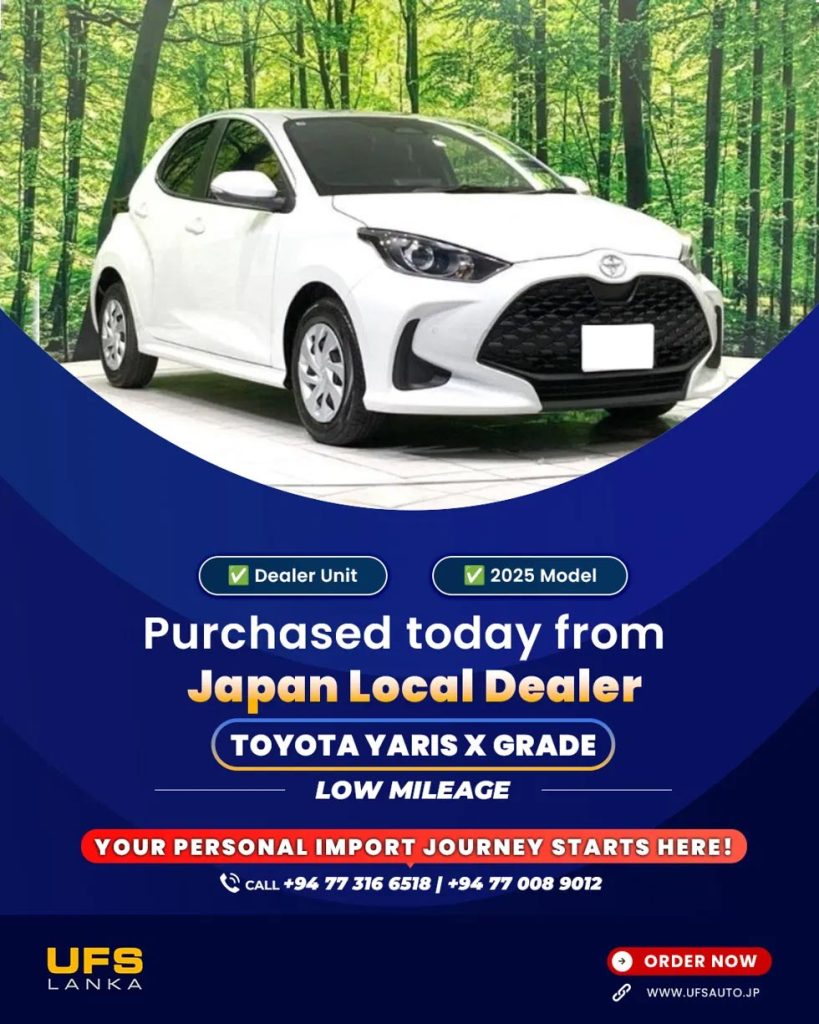
Sometimes the right car isn’t at auction this week, but a Japanese dealer has one in stock. Dealer units are often very low-mileage, recent cars. One recent example: we bought a 2025 Toyota Yaris X Grade, low mileage, from a Japan local dealer at a CIF price of ¥1,612,400 for a Sri Lankan customer.
Dealer cars don’t come with an auction sheet, so ask for detailed photos, the dealer’s condition and maintenance records, and the export inspection certificate.
The biggest red flag: a missing auction sheet
If an exporter says a car came from auction but can’t or won’t show you the auction sheet, treat that as a warning sign. Common excuses include “it got lost”, “we bought it from a private owner” and “don’t worry, our mechanic checked it”.
The auction sheet is an independent third-party report. It’s what reveals rolled-back odometers, accident repairs (grades R or RA), and serious underbody rust. Exporters who hide it usually have a reason.
Stage 4: Proforma invoice and Letter of Credit (LC)
Once the car is secured, the exporter issues a proforma invoice: a formal quotation with the car’s details and the CIF price (cost, insurance and freight to Sri Lanka).
You take that invoice to your bank to open an LC.
What an LC is, in plain terms: your bank promises to pay the exporter, but only once the exporter provides proof that the car has been shipped as agreed. It protects both sides. The exporter knows the money exists, and you know the money is released only against the right documents.
What to expect:
- LC transmission: usually 1–3 days once the bank has everything.
- The bank sets aside (earmarks) the funds for the car payment.
- Exchange-rate risk: the car is priced in Japanese yen, so the rupee cost can move between quotation and payment. Keep a margin in your budget.
Talk to your bank early. Each bank has its own requirements and charges for import LCs.
Stage 5: Export inspection and shipping
While your LC is being processed, the car is prepared in Japan:
- The exporter arranges the required pre-export inspection, such as a JAAI certificate or JEVIC certificate, depending on what applies.
- The car is booked onto a vessel, and you get the shipping details: vessel name and expected departure.
- Once loaded, a Bill of Lading (BL) is issued. This is the shipping document that proves your car is on board.
Typical timing: about 2 weeks from LC to loading, then about 12–14 days on a direct voyage to Hambantota.
Shipping times are the part most likely to change. Vessel schedules, transhipment and port congestion can add days or weeks. Plan around a range, not a single date.
Stage 6: Documents and payment through your bank
After shipment, the exporter sends the shipping documents to your bank under the LC terms. These usually include the BL, commercial invoice, inspection certificate and other LC documents.
Your bank checks them, makes the payment to the exporter, and releases the documents to you or your authorised agent for clearance.
Stage 7: Tax paperwork. Start this while the car is at sea.
This is where many first-time importers lose time. Don’t leave it until the ship arrives.
- TIN (Taxpayer Identification Number). Since 5 January 2026, the Department of Motor Traffic links every car, van, SUV and lorry registration to the owner’s TIN. Registration is free on the IRD e-Services portal. Our guide Do you need a TIN to buy a vehicle in Sri Lanka? covers the latest rules, including the IRD’s postponement of the mandatory TIN certificate to 1 April 2027.
- Temporary VAT registration. Importers without a permanent VAT registration can apply for Temporary VAT through the IRD portal. Sri Lanka Customs says the application needs the Bill of Lading, so you’ll usually apply while the car is in transit. Sri Lanka Customs’ FAQ also says first-time personal vehicle importers are not required to submit a VAT or TIN certificate for their first import. Rules here change often, so confirm what applies to you with your clearing agent.
- Customs registration. Have these ready: your TIN details, a digital passport-size photo, an active email address, a mobile number ownership confirmation letter, and your bank and import documents.
Tip: Make sure your name and address match exactly across your tax, bank and import documents. A mismatch causes more delays than almost anything else.
Stage 8: Customs clearance and release
When the car arrives:
- A licensed clearing agent usually handles clearance for you. If you need help finding one, UFS Lanka can assist.
- Sri Lanka Customs issues an Assessment Notice showing the duties and taxes due.
- You pay the assessed amount through an accepted payment channel.
- Once customs procedures are complete, the car is released.
Clearance typically takes about 5–7 days once the car is offloaded and the documents are ready, but it can take longer.
How long does it take? The timeline at a glance
| Stage | Typical time |
|---|---|
| Choosing the car and winning a bid | Varies: a few days to a few weeks |
| LC transmission | 1–3 days |
| Export inspection and loading | About 2 weeks after the LC |
| Shipping Japan → Hambantota (direct) | About 12–14 days |
| Temporary VAT registration | About 5 working days (can run during shipping) |
| Customs clearance | About 5–7 days after offloading |
Total: after the car is secured, a smooth import usually takes around 5–7 weeks to release. Some stages overlap, and shipping or customs delays can stretch this considerably. These figures are estimates, not guarantees.
Budgeting for the real landed cost
The auction or dealer price is only the start. Budget for the full landed cost:
- Vehicle price (auction hammer price or dealer price)
- Export inspection, freight and insurance (included in the CIF price)
- Exporter or service fees
- Bank charges for the LC
- Customs import duty and other taxes on the Assessment Notice
- Port, handling and storage charges
- Clearing agent fees
- Registration costs
- A margin for exchange-rate movements and possible delays
Duties change. For example, a temporary 50% surcharge on Customs Import Duty for many vehicle categories has been in force through 2026 and is currently scheduled to end on 31 December 2026. See our explainer on the vehicle import duty surcharge. Always get a current estimate before you bid.
For a real CIF example, see our Toyota Raize Hybrid CIF price guide.
5 lessons for first-time importers
- Choose a verified exporter who explains fees, payments, responsibilities and refund terms clearly, in writing.
- Always see the auction sheet before you authorise a bid, or a full condition report for a dealer car.
- Understand your LC and exchange-rate risk before you commit.
- Get your TIN and IRD paperwork sorted early, ideally before the car ships.
- Budget for the full landed cost, not just the price in Japan.
Thinking about importing your next car?
Personal import takes some effort, but buyers who prepare well usually end up with a better car at a better price than they’d find locally.
If you’d like help, UFS Lanka can guide you through each stage: choosing the model and grade, sourcing from Japanese auctions and dealers, sharing auction sheets and condition reports, coordinating shipping, and helping with clearance if you need it.
🚗 Got your dream car in mind?
Send us the model and grade on WhatsApp, and we’ll reply with a free, no-obligation import quote.
💬 Get My Free Quote on WhatsApp
WhatsApp: +94 77 008 9012 · Prefer to talk? Call +94 77 316 6518
Frequently asked questions
How long does it take to import a car from Japan to Sri Lanka?
After the car is bought, a smooth import usually takes around 5–7 weeks: about 2 weeks to loading, 12–14 days of shipping on a direct voyage, and about 5–7 days for customs clearance. Delays in shipping or paperwork can extend this.
Can I import a car from Japan under my own name?
Yes. In a personal import, you are the importer, so you open the LC in your name and the car is cleared and registered to you.
Who opens the Letter of Credit?
You, the importer, open the LC with your bank using the proforma invoice from the exporter.
Do I need a TIN to import a car?
You need a TIN to register a car, van, SUV or lorry in your name in Sri Lanka. The IRD has postponed the mandatory TIN certificate for vehicle registration to 1 April 2027, but registering for a TIN is free and worth doing early. More on TIN rules.
Is a car from a Japanese dealer as safe as an auction car?
It can be, if you get full photos, the dealer’s condition records and the export inspection certificate. For auction cars, always ask for the original auction sheet.
Disclaimer: Timelines and costs in this guide are estimates based on our experience and are not guaranteed. Import duties, tax requirements and customs procedures in Sri Lanka change regularly. Check current rules with Sri Lanka Customs, the Inland Revenue Department and your bank before importing.