

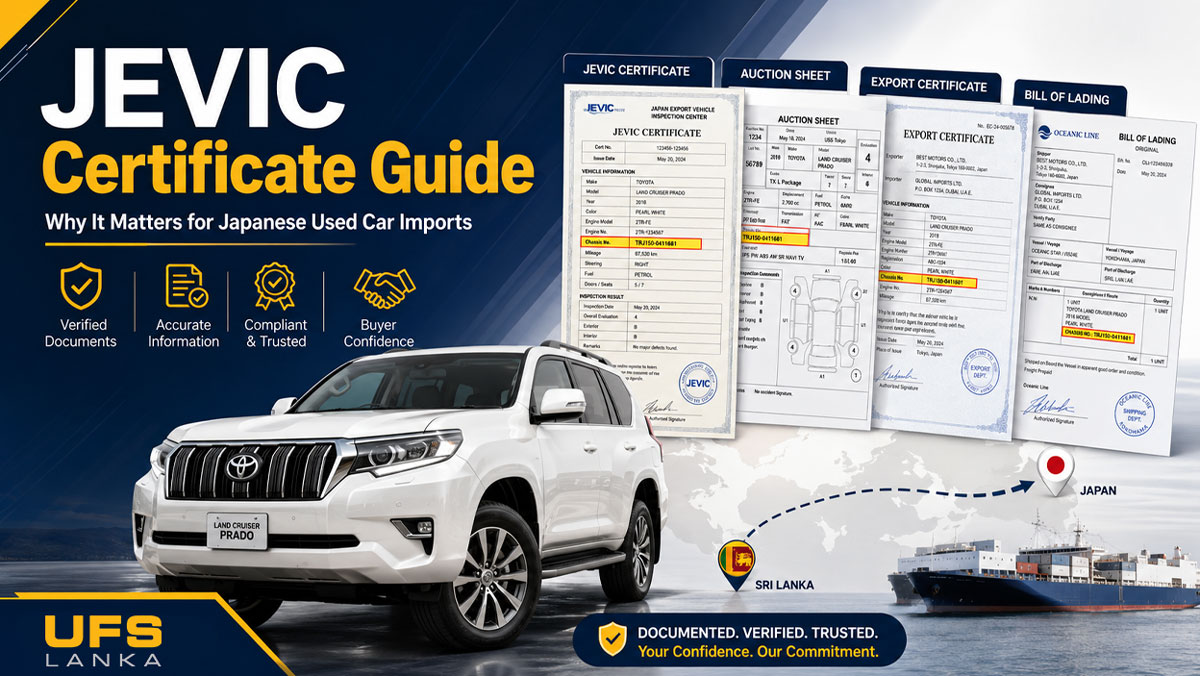
If you are importing a used vehicle from Japan, you have probably already checked the auction grade, mileage, photos and final CIF price. But from our side at UFS Auto, we always remind buyers that the vehicle is only one part of the deal, because the documents must be right too. In this guide, we will explain what the JEVIC certificate is, why it matters for Sri Lanka and other import markets, and how to check it before the vehicle leaves Japan.
Key Takeaways
- JEVIC certificate is a Japan-side pre-shipment inspection certificate used for selected used vehicle exports.
- Sri Lanka Customs requires used motor vehicles under HS codes 87.02, 87.03, 87.04 and 87.05 to have a certificate of export inspection from authorized inspectors.
- JEVIC Company Limited is registered in Japan and its official business includes vehicle inspection, vessel inspection and vehicle pre-shipment inspection of containers.
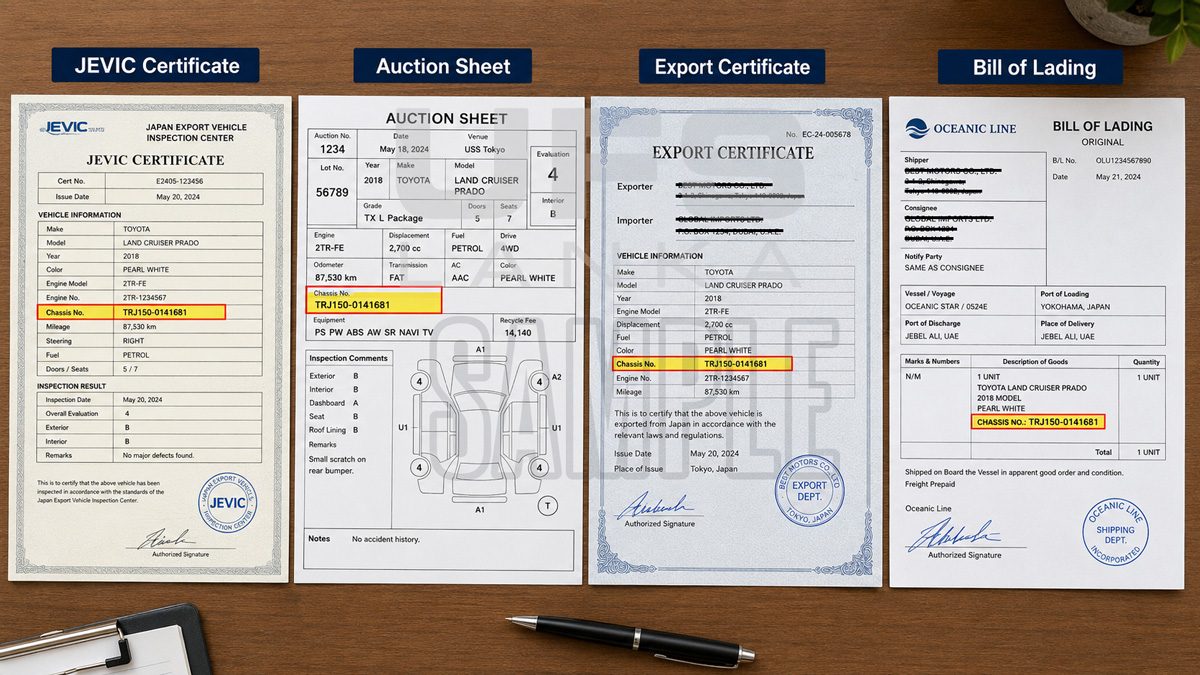
- Document matching is very important because the chassis number must match across the auction sheet, export certificate, invoice, JEVIC certificate and Bill of Lading.
- Auction sheet and JEVIC certificate are not the same document, so buyers should check both before shipment.
- UFS Auto support helps buyers understand inspection requirements, document flow and Japan to Sri Lanka vehicle import steps.
What Is a JEVIC Certificate?
A JEVIC certificate is a pre-shipment inspection certificate issued after a used vehicle is inspected in Japan before export. JEVIC stands for Japan Export Vehicle Inspection Center Company Limited, and its official company profile lists vehicle inspection, vessel inspection and vehicle pre-shipment inspection of containers as its business activities.
In simple words, this certificate helps show that the vehicle has gone through a Japan-side inspection before shipping. For buyers, that matters because the inspection certificate becomes part of the vehicle’s import document file, not just an extra paper.
Statistic: JEVIC Company Limited was registered in Japan on 27 September 2001 – Source: JEVIC, 2026
For Sri Lankan buyers, this is why we always say, “Do not only look at the car. Look at the documents also.” A clean vehicle with missing or wrong documents can still create clearance delays.
For a related document guide, see our JAAI certificate Sri Lanka vehicle import guide.
Why Is a JEVIC Certificate Important for Japanese Used Car Imports?
A JEVIC certificate is important because it supports compliance, buyer confidence and smoother import processing before the vehicle reaches the destination country. Sri Lanka Customs regulations state that used motor vehicles under HS codes 87.02, 87.03, 87.04 and 87.05 being imported to Sri Lanka must be subjected to pre-shipment inspection and must have a certificate of export inspection from relevant authorized inspectors.
This is not something buyers should leave until the last minute. Once the vehicle is already on the vessel, correcting certificate issues or document mismatches becomes more difficult.
Statistic: Sri Lanka Customs lists JAAI, JEVIC and USS Co., Ltd. among authorized inspectors for imports from Japan — Source: Sri Lanka Customs Gazette, 2013, published by Sri Lanka Customs.
At UFS Auto, we treat inspection documents as part of the buying decision. A good price is useful, but a good price with proper documents is what protects the buyer.
For a full process overview, visit our Japan to Sri Lanka vehicle import support page.
Is JEVIC Accepted for Sri Lanka Vehicle Imports?
A JEVIC certificate is accepted for Sri Lanka vehicle imports when it is issued by Japan Export Vehicle Inspection Center Company Limited as an authorized inspector for imports from Japan. Sri Lanka Customs lists Japan Export Vehicle Inspection Center Company Limited, known as JEVIC, as one of the authorized inspectors for imports from Japan.
This point is very important for Sri Lankan buyers. If your selected vehicle needs an inspection certificate, you must confirm the correct inspection body before shipment.
Statistic: JEVIC’s official vehicle function inspection page states that its vehicle function inspection is accredited by government agencies of Fiji, Papua New Guinea, Mauritius and Sri Lanka – Source: JEVIC, 2026
For example, if a Sri Lankan buyer imports a Toyota Raize, Honda Vezel, Audi A3 or Suzuki Every from Japan, the inspection requirement should be checked during the buying stage. This avoids confusion when the vehicle reaches customs clearance.
For model-specific buying advice, browse our Japanese used cars for Sri Lanka buyers.
What Does JEVIC Check During Vehicle Inspection?
A JEVIC inspection checks selected vehicle condition, safety and compliance areas before export, depending on the destination country requirement and inspection type. JEVIC’s official services include quarantine inspection, vehicle structural inspection, odometer inspection and vehicle function inspection.
The exact inspection scope can change depending on the destination country and regulation. So the safe approach is simple: confirm the inspection requirement before the vehicle is shipped.
Exterior and Body Condition
Exterior condition is the visible body condition of the vehicle, including panels, lights, mirrors and other outside parts. This matters because a car can look good in auction photos but still need closer checking.
For example, a bumper clip, cracked light or rust mark may look small in photos. But if it affects inspection or road-use condition, it should be identified early.
Interior and Basic Functions
Interior inspection looks at cabin condition and basic usability, including seats, belts, switches and dashboard items. This is important because Sri Lankan buyers usually want a car that feels clean, fresh and ready for family use.
For example, power windows, air conditioning, dashboard lights and warning lamps should be checked before shipment. Small faults can become expensive after the car lands.
Odometer and Vehicle History
Odometer inspection helps verify mileage consistency against available historical readings. JEVIC officially lists odometer inspection as one of its vehicle inspection services.
This matters because mileage is one of the biggest price factors in Japanese used cars. A low-mileage vehicle should always be supported by proper documents and inspection records.
For buyers comparing mileage, grades and condition notes, our Japanese auction sheet verification guide for Sri Lanka buyers is a useful next read.
JEVIC Certificate vs Auction Sheet: What Is the Difference?
A JEVIC certificate is an inspection document, while a Japanese auction sheet is an auction condition report used to understand the vehicle before purchase. These two documents support different parts of the buying process.
The auction sheet helps you understand the vehicle’s grade, scratches, dents, mileage, repair notes and interior condition. The JEVIC certificate supports the pre-shipment inspection and export document process.
| Document | Main Purpose | When Buyer Should Check | Why It Matters |
| Auction Sheet | Shows auction condition and grade | Before bidding or confirming purchase | Helps avoid accident, repair or condition surprises |
| Export Certificate | Confirms Japan-side export registration details | Before shipping | Supports export and destination documentation |
| JEVIC Certificate | Confirms inspection based on destination rules | Before vessel loading | Supports compliance and clearance |
| Bill of Lading | Confirms shipment details | After vessel booking | Needed for destination clearance |
| Commercial Invoice | Confirms price and buyer details | Before payment and clearance | Used for customs and payment records |
This is why we always advise buyers to check the full document set. One document alone does not tell the full story.
How to Verify a JEVIC Certificate Before Shipping
A JEVIC certificate should be verified by checking the chassis number, vehicle details, inspection body, certificate details and consistency across all export documents. This simple check can prevent many avoidable import problems.
Start with the chassis number. The chassis number must match across the auction sheet, export certificate, invoice, JEVIC certificate and Bill of Lading.
Next, check the make, model, year, mileage and inspection date. If any detail looks different, ask for clarification before the vehicle is loaded.
Then, confirm whether the inspection body is accepted for your destination country. Sri Lanka Customs lists JEVIC as an authorized inspector for imports from Japan, but the buyer should still confirm the requirement for the specific vehicle and shipment.
Here is a simple buyer checklist:
- Check the chassis number across every document.
- Compare the mileage with the auction sheet and export certificate.
- Confirm the inspection body before shipment.
- Check the inspection date and certificate details.
- Match the buyer and invoice details with the shipment documents.
- Ask for clarification early if anything does not match.
By checking these points before shipping, you can reduce the risk of clearance delays.
What Documents Should Buyers Check With the JEVIC Certificate?
A JEVIC certificate should be checked together with the auction sheet, export certificate, invoice, Bill of Lading and destination clearance documents. The certificate is important, but it works best when the full file is complete.
At UFS Auto, we usually look at the document flow as one connected chain. If one link is weak, the whole process can slow down.
The key documents are:
- Auction sheet
- Export certificate
- JEVIC certificate
- Commercial invoice
- Bill of Lading
- Shipping schedule
- Customs clearance documents
For example, if the export certificate shows one chassis number but the invoice has a typing error, the clearing process can become stressful. That is why early document checking is better than waiting until the car lands.
For import process support, visit our UFS Lanka Japan to Sri Lanka car import support.
Practical Tools to Check JEVIC and Import Documents
A practical document-checking process uses official inspection records, auction sheet review, export document matching and customs requirement confirmation before shipment. This is not complicated, but it must be done carefully.
You can do this using UFS Auto’s Japan-side support, auction document review and export document coordination. Free alternatives include checking the official JEVIC website for company and service details, and reviewing Sri Lanka Customs notices for inspection requirements.
A good tool does not replace buyer awareness. It simply makes the checking process cleaner and faster.
What’s Next After Checking a JEVIC Certificate?
The next step after checking a JEVIC certificate is to confirm the full document file, shipping schedule and destination clearance plan before the vehicle leaves Japan. This step protects the buyer from last-minute problems.
First, confirm that the inspection requirement is complete. Then check that the export certificate, invoice and shipment details are ready.
Next, ask for the vessel details, ETD and ETA. These details help you plan payment, clearing, insurance and final delivery.
Finally, keep all documents organized by chassis number. This is especially useful when you are importing more than one vehicle or comparing several Japan auction options.
At UFS Auto, we help buyers with the complete flow from vehicle selection to Japan-side export coordination. That way, the buyer is not left alone after the auction is won.
Conclusion
A JEVIC certificate is an important inspection document that helps support safer and smoother Japanese used car imports. It is not just another paper in the file.
For Sri Lankan buyers, the safest way is to check the auction sheet, export certificate, JEVIC certificate, invoice and Bill of Lading before shipment. This small effort can save time, money and stress later.
At UFS Auto, we always believe that a good import starts before the car leaves Japan. If you have a question about JEVIC, JAAI, auction sheets or Japan to Sri Lanka vehicle import documents, drop your question in the comments or message UFS Auto on WhatsApp.
Good Imports Start Before the Car Leaves Japan
At UFS Auto, we always believe that a good import starts before the vehicle leaves Japan. If you have a question about JEVIC, JAAI, auction sheets, export certificates or Japan to Sri Lanka vehicle import documents, we are here to guide you clearly.